Mar 23, 2019

Chunsoft and Sound Novels


I remember when visual novels weren't quite known as well as they are today. By no means are visual novels a mainstream genre of video games--in fact you won’t be hard pressed to find some “expert” try to argue with you over how they are not games at all--but their notoriety is far more than that of even just ten years prior. For the longest time visual novels were seen as just an anime fandom “thing” that mainstream gamers paid no mind to. Very few titles were discussed outside those that had animes be it a TV series or an erotic OVA, and even some of the earliest visual novels localized into English were done so by anime and manga translation companies and not actual video game publishers. 

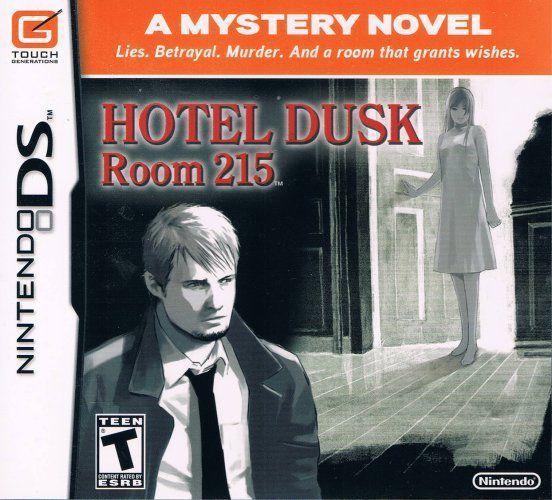
If I had to pinpoint a time in my own memory where the genre started to get noticed more it would be when the Nintendo DS took off. With the DS there was an increase amount of western releases for visual novels thanks in large part to its touch screen interface working well with adventure style games. This wasn't just noticed by Japanese developers either as a fair share of American and European made adventure style games were developed for the console as well. It seems everybody was anxious to utilize the system’s unique features when the DS started soaring in popularity. The point ‘n click and visual novel genres really had a home on the DS, and because of that a lot of people outside of just the anime community got a taste of these kinds of games with beginner friendly titles such as Ace Attorney, Trauma Center, and Hotel Dusk. 

However, despite the Nintendo DS (and later to a lesser extent the PSP and PS Vita) giving gamers a finely curated and easily digestible dose of the genre I’d say the sad thing is the push was pretty small and died out quickly. Instead what seems to be the biggest reason why most video game outlets nowadays talk about visual novels are because of the parody dating sims that started to grow in popularity. Hey, do you want to date some monster? Is your girlfriend a llama? Maybe all you need in your life is to date a pigeon. Don’t try to hide it, we all know you secretly wish you could go out with a YouTuber. Not into dorky millennials, well no problem, we got a game for you--that is if dating other people’s dads is a you thing. Yes, this is the era of the wacky, silly dating sims taking over in the English market. It wasn't always like this however, and yes Japan has had a long history of doujin dating sim parodies themselves, but lately it feels like all people know are the parodies that make good YouTube videos to react to instead of what a large amount of the games in the genre can offer.

Don’t get me wrong however, I’m by no means saying parodies do not have a place nor should they stay out of the limelight, and I definitely love that this fad has ushered in a wave of indie made English titles--but simply put this wave lacks so much variety and has been stretched so thin by this point. For every one creative title that pushes boundaries and gets new people interested in visual novels there are ten bland titles spilled all over Steam that feel like they were made by people with barley a grasp on what a visual novel can be outside of either parody dating or “boobies are pretty awesome”. Some of these bland games are even really well made and have a lot of care and attention added to their interfaces and artwork, but when push comes to shove, they are still just a basic joke stretched to its thinnest level. Visual novels don’t have to be that however, and while most mainstream gaming outlets may still be joking about how great it is to date your kitchen appliances, you don’t have to (unless you want to, in which case I recommend dating the toaster for he is the bravest of all kitchen dwellers).

A lot of this misunderstanding can be tied into the nebulous relationship between visual novel and dating sim, two “genres” that many people debate are separate things entirely yet due to the overlapping nature of the two they are often confused for each other. There’s a great article by Brian Crimmins online that actually goes into heavy detail about how visual novels came to be as a genre and how over time both visual novels and dating sims affected and evolved each other. It’s a wonderful read that I really recommend it for anyone curious about games such as these, but either way, whether or not you think visual novels and dating sims are the same thing or should be counted as separate but similar genres of games; it certainly doesn't seem to stop most western gaming outlets reporting solely on gag dating sims as visual novels and taking away a majority of people’s attention from so much more that these games can offer. 

I take back all my complaints
I somewhat lost focus and started rambling today, so let’s move on now and finally discuss what I wanted to talk about--that being, despite there being well known visual novel developers to the tight knit community that follows games such as these--examples including but not limited to: Mages, Type Moon, or Nitroplus--my favorite developer often seems forgotten in the conversation. What company is that you ask? Well, it’s Chunsoft. So today I want to talk about why Chunsoft really should be talked about more in the western fandom and all their contributions to the genre.

Chunsoft is one of the many long standing Japanese developers that have been around for every major home console since the Famicom. Nowadays they are known as Spike Chunsoft after their merger with Spike Co. in April of 2012. For the sake of this blog post however I am mostly going to refer to them as Chunsoft still given everything I really want to talk about predates the merger. Chunsoft’s involvement with Japanese style adventure games and visual novels more or less are tied to the very beginning of the genre. There isn't quite a de facto known “first” visual novel per se, but most fans put the starting line at around 1982 or ‘83 depending on which game they may be talking about and which source they want to use for the release date (remember release dates were not entirely clear back in these early days). 
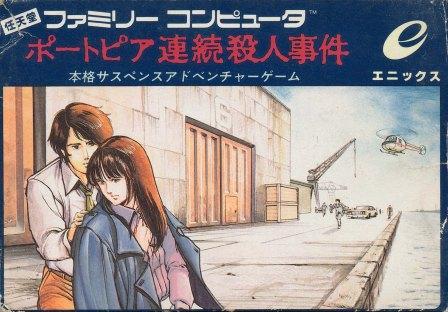

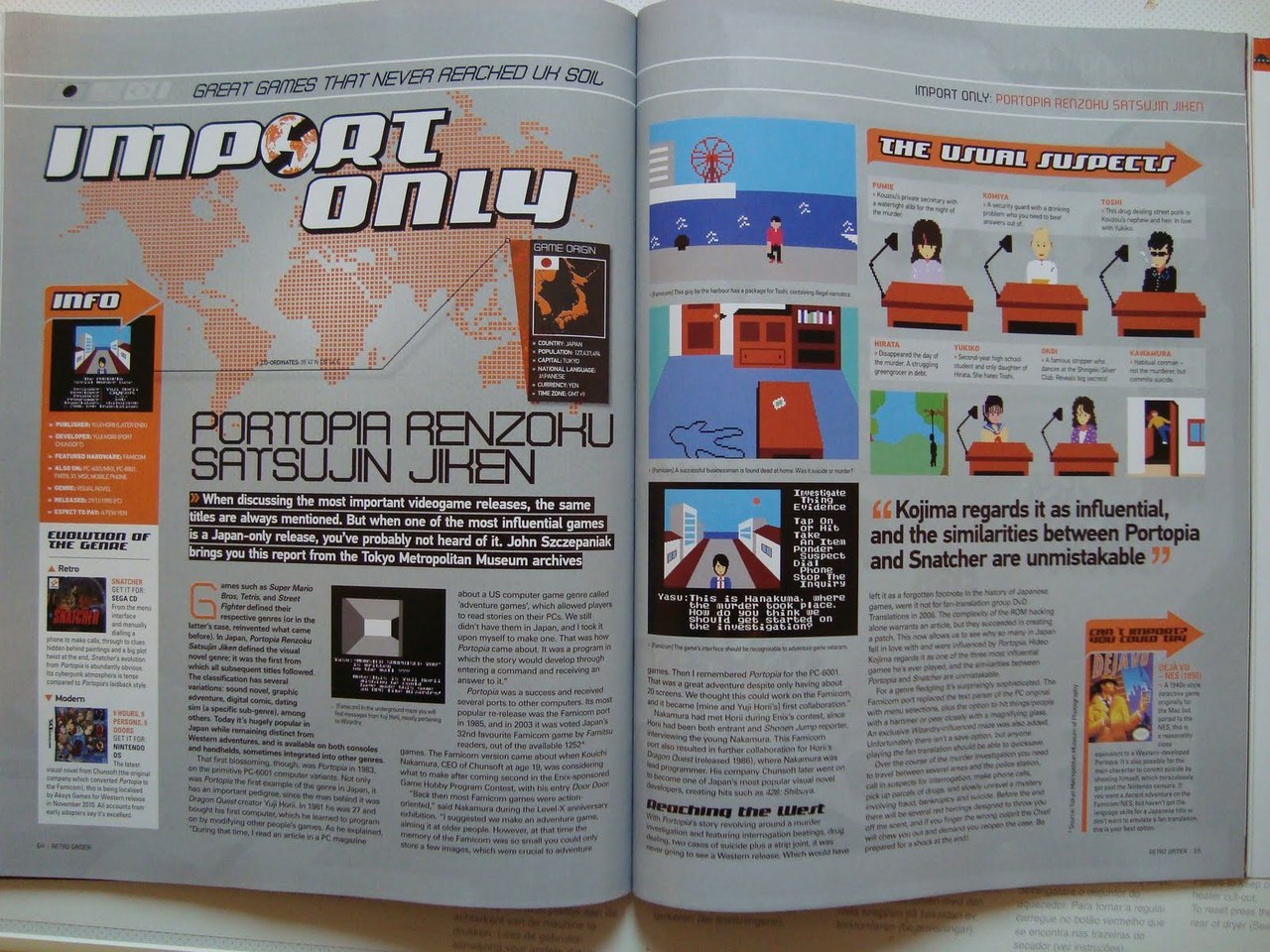
One of the earliest contenders for this honor is Yuji Horii’s adventure game The Portopia Serial Murder Case (Portopia Renzoku Satsujin Jiken), a game that was based around Horii’s interest in western style adventure titles, much like Horii’s later known legendary game Dragon Quest was based around his fascination with Wizzardy and Ultima and how to replicate those games in an easier to understand interface for his home nation. It’s here we can see “visual novel” wasn't even a blip on the radar yet, and there was no definitive understanding of what genres for games really were at the time. Portopia proved to be a major hit during its release however and lives on even to this day as a fondly remembered game (and also a Japanese internet meme). Chunsoft handled the porting of the title to the Famicom and this was the beginning of a long business relationship between Chunsoft president Koichi Nakamura and Enix’s own Yuji Horii as in the years to follow Chunsoft would develop the first five entries in the hit Dragon Quest franchise for Enix.

With the birth of the Super Famicom things began to change between both Enix and Chunsoft. Having developed games primarily for the publisher Enix Chunsoft felt they should move into their own publishing, and soon got certification from Nintendo to do so. After slaving away on four Dragon Quest titles on the Famicom, and also working on the fifth title for the Super Famicom, most of the employees at Chunsoft were burned out so they decided their first self published title should be a simple game. Koichi Nakamura wanted to help make gaming more accessible at the time and took both the team’s exhaustion and his desire for a more casual audience into consideration when they moved forward. 

The title Nakamura needed to make had to be simple; a game that anyone could be able to figure out to navigate--even those intimidated by a controller, but despite that also needed to take advantage of the more powerful hardware of the Super Famicom by using Kanji scripts which again would make the experience easier on casual players who had trouble getting into video games because game consoles prior could only display text entirely in Hiragana or Katakana making the reading experience poor and hard to enjoy for Japanese players (see Japanese writing systems for more details). To all these ends the team at Chunsoft decided to create a game entirely around reading to tackle this Hiragana issue and show off the hardware (or at least the hardware’s Kanji capabilities) while also being something anyone of any gaming skill level could enjoy. The game would mostly be text for the player to navigate through and present choices at key moments in the story to advance, cutting out any complicated aspects from western adventure style games that might intimidate the unfamiliar such as solving puzzles or finding hidden items. This is how Otogirisō was born. 
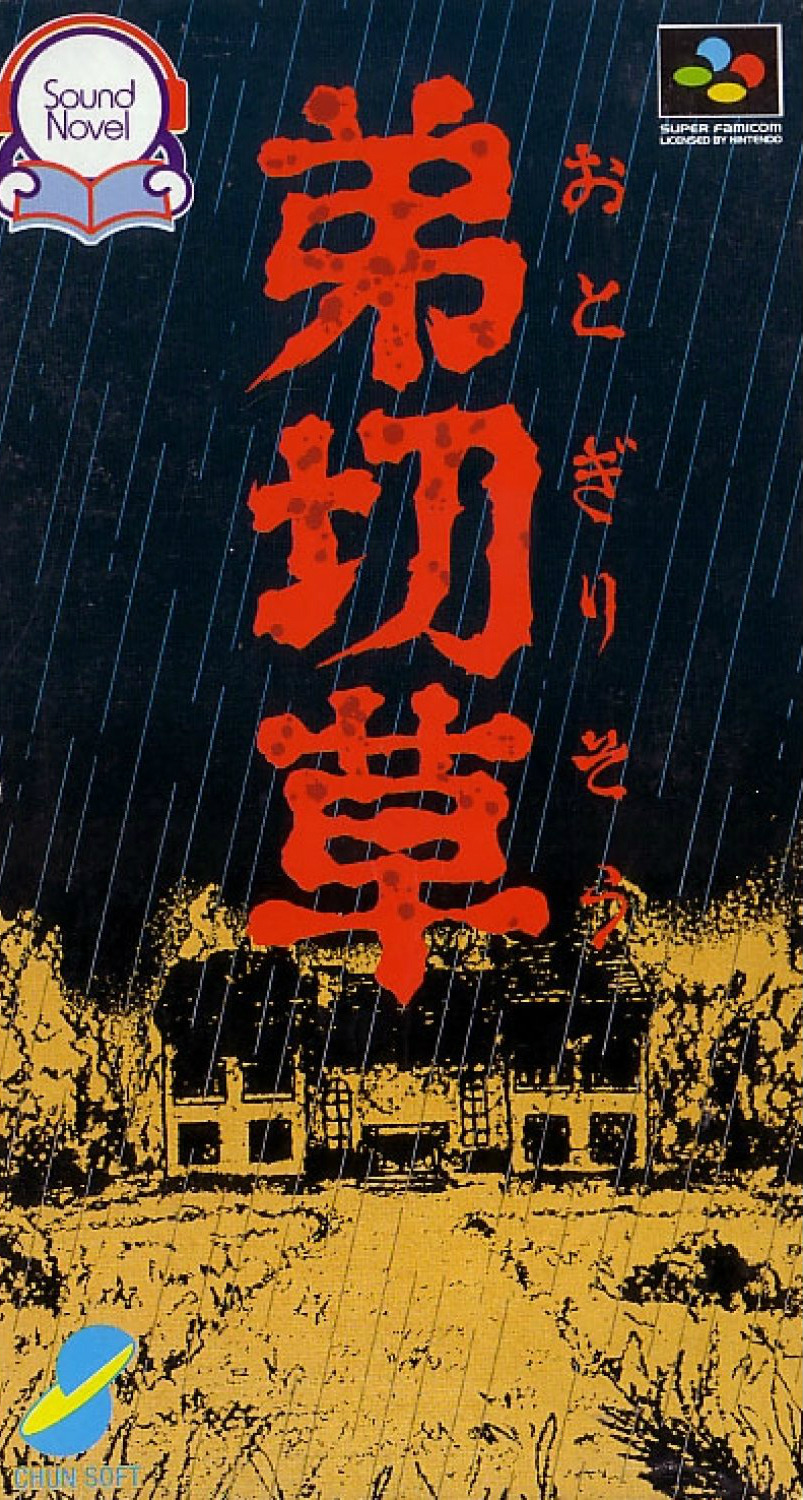

Otogirisō (Japanese for St John Wort) was Chunsoft’s very first sound novel, a nomenclature which has since confused the hell out of everyone. But what exactly is a sound novel you may ask? Well, people get kind of convoluted about it. Looking at the definition currently found on Giant Bomb a sound novel can be defined by its heavy reliance on sound effects and music to create a game's atmosphere. Usually sound novels will use minimalist visuals and choose to emphasize the text over the artwork presented on screen--most commonly covering the entire screen in said text instead of keeping text only contained in a dialogue box. Something among these lines is the definition usually seen online when you look into it. It’s not entirely wrong either, but it’s also missing something to it. The term sound novel is a creation of Chunsoft themselves, and something they own a copyright on, this is also often brought up when you search sound novel, but at the time of its creation sound novel was meant to be something really easily understood and not this tangled mess of “a certain kind of visual novel”. 

When Chunsoft first created Otogirisō the brand sound novel was added to its box in order to help potential customers understand what kind of game it was. At the time it was just a way to let people unfamiliar with adventure style games (more commonly found in the west) to understand that this title will largely feature reading. In fact when Otogirisō was originally shown to the press in a 1991 Nintendo Space World show the game looked radically different from its finished project. Otogirisō was presented mostly as a book that the player would read, pretty much just like modern e-readers are now, with the exception that it included some sound effects and music. The press at the time was underwhelmed by this so Chunsoft took the game back to the drawing board and created unique visual backgrounds to give the game more flair and in doing so set a certain precedence for future visual novels to follow in. 

An important factor to remember here is there was no clear cut way to define games such as these yet. The term visual novel had not yet been coined, and even gamers themselves were not very well aware of genres. As Nakamura admits in a Famitsu interview when asked about the creation of sound novels, “if you look back at the very beginning of video games, for me, the conception of “genre” didn’t exist. Take action games, for example: within that label you had shooting games [note: Shoot ‘em Ups], you had stuff like Pac Man and Dig Dug, and you had more puzzle-y games too. It was very diverse. On the same note, with adventure games, there were Ascii Magazine’s games like Ometesandou Adventure and Minamiseizan Adventure, which were pure text adventures… but you also had things like Mystery House, which had a few pictures, or war simulation games like Fleet Commander. I played all those, and while I recognized there were many different types of games, I never thought about it in terms of genres.” So basically, at the time sound novel was conceived it was just meant to be the most straightforward way to define this Japanese style of adventure gaming that Chunsoft was trying out on the Super Famicom. 


But does it end there? Well no. That’s only the part of the answer. Otogirisō ended up being a modest sleeper hit upon its release and this lead to Chunsoft to making more sound novels, with their next title being a legendary game that has since eclipsed Otogirisō as the de facto sound novel; Kamaitachi no Yoru (Night of the Sickle Weasels). This game was a hit, there’s no easy way for me to describe just how big it really was back during its release--out of the pantheon of legendary Japanese games that people in the US and Europe know jack about Kamaitachi no Yoru is one of the highest. Kamaitachi no Yoru is a fantastic game and I talked about it ad nauseum a few years ago when I payed the localized version called Banshee’s Last Cry, check that out if you’d like to know more, and if you’re still somehow able to play it then you’re definitely in for a darn good time.

With the a string of successes in the visual novel marketplace after both Otogirisō and Kamaitachi no Yoru, Chunsoft kept churning out games over the years, many of which are highly respected by the fandom still such as Machi and 428: Shibuya Scramble. All these releases of theirs had a certain tone and atmosphere, not to mention a distinct presentation that didn’t change much over the years and because of that did not look like what visual novels typically look like now. There’s a certain charm and narrative style between all of Chunsoft’s sound novels that is a really strong defining link in their catalogue despite a lot of these games being stand alone--and because of that people come to expect certain things upon seeing the term sound novel. Many titles would eventually come out not made by Chunsoft that shared similarities to their brand--these games followed in the footsteps of Chunsoft’s tone, structure, style, and presentation--and people began to notice, the most famous of which being 07th Expansion’s Higurashi doujin series. This is where we begin to see that murky kind of convoluted aspect of sound novels, as they start to transcend a basic label put on a box almost three decades ago and turn into their own little sub genre or maybe better described as their own style of visual novel. 

So what the heck is a sound novel then? The simplest answer is a sound novel is a dated term that Chunsoft used regularly and has since fallen out of use for visual novel; the more complicated answer is that sound novels are both a term used by Chunsoft for their brand of visual novels back before the term visual novel existed and also a certain style of visual novel that is mostly inspired by the early Chunsoft games’ presentation and ambiance. 
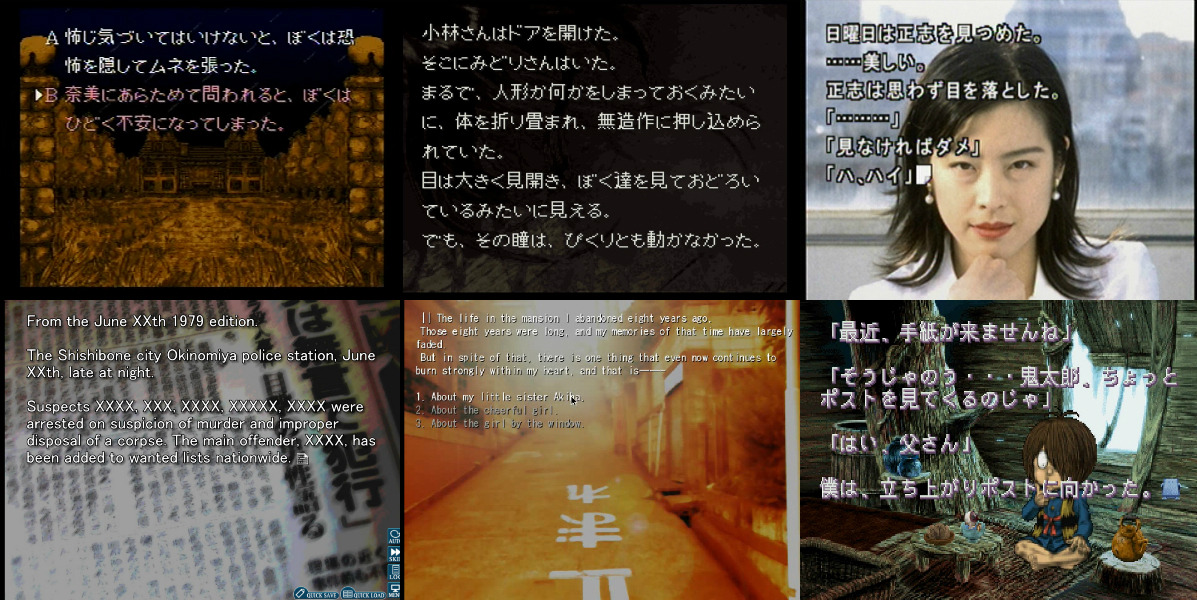
Top Left to Right:
Otogirisō - Chunsoft '92, Kamaitachi no Yoru - Chunsoft '94, and Machi - Chunsoft '98
Bottom Left to Right:
 Higurashi When They Cry - 07Expansion 2002,  Tsukihime - Type Moon 2000,
and GeGeGe no Kitaro Maboroshi Fuyu Kaikitan - Bandai '96
Over the years Chunsoft has expanded, changed, and moved beyond their sound novel brand. Despite this however, they have never really stopped putting out solid titles in the visual novel market, and it seems like each new generation of gaming is blessed with at least one visual novel of theirs. My personal favorite title out of all their work from this era would definitely have to be 999: Nine Hours, Nine Persons, Nine Doors on the Nintendo DS. It was because of this game in particular that my love of visual novels in general really started, and Kotaro Uchikoshi’s sharp writing--especially the incredible dialogue and thorough thought narration in protagonist's Junpei’s head still stands at the peak in my mind. Throw in beautiful sprite work based around art from legendary Capcom (and now freelance) artist Kinu Nishimura, and a fantastic soundtrack from the man himself, Shinji Hosoe and you got yourself a meeting of some fantastic minds. I've written about 999 in the past, and you can read about it here, but I still want to write more about it in the future, especially tackling the latest release it got in 2017’s Zero Escape: The Nonary Games

Recent years have seen Spike Chunsoft make it big with their Dangan ronpa franchise, admittedly however the first Dangan ronpa title should be more attributed to Spike, as the game was released in 2010 two years before their merger. However the two companies together as one have since released three more Dangan ronpa games, and two (or is it three?) Dangan ronpa anime titles, and many, many rereleases and compilations. My own interest in the franchise isn't nearly as strong as everyone else’s seem to be but I did however absolutely adore the last game, Dangan ronpa V3, with how many times it managed to jump the shark, upping the game, and constant plot twist after more ludicrous plot twist. If there was ever a way to end something like Dangan ronpa it was what that game did, and oh boy did I get a kick out of that. 

Finally moving past Dangan ronpa, 2019 will see Spike Chunsoft develop and publish Kotaro Uchikoshi’s newest game, AI: The Somnium Files, for the Nintendo Switch, PS4, and Steam which just got its newest trailer and release date announced earlier this week. I am very excited for it personally and love the intricate and complex alternate reality game type marketing the team has been using to build up to its release! This is some next level stuff, and has been tons of fun all on its own.
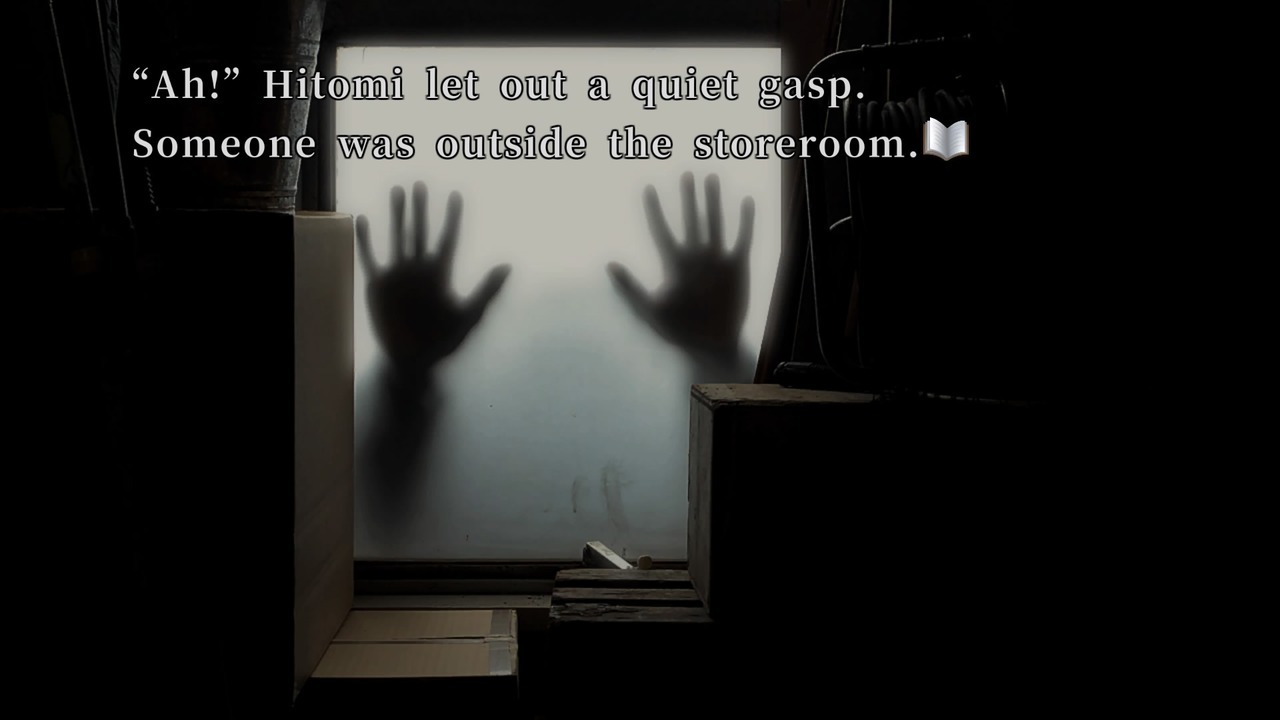

Then there’s of course one more game I simply cannot pass up mentioning, 428: Shibuya Scramble. Now I briefly spoke this title earlier mentioning later sound novels that have been highly acclaimed, and trust me 428 is definitely beloved; its perfect score in Japanese gaming magazine Famitsu really meant something back in 2008 on the Wii. But why mention this with recent Spike Chunsoft games? Well the answer is easy, 2018 saw the much beloved, super Japanese game finally get an American and European release! And much celebration was had! If anything in this whole blog post remotely sounded interesting to you I really implore you all to go check it out either on the PS4 or Steam, and see what a Chunsoft sound novel is all about. And for the impatient, I will be writing about it next on blog! 

Despite Chunsoft changing over time and no longer using their sound novel brand, they have still put out many classic and fantastic games in the visual novel genre. Their later work may take a radically different presentation from their prior titles, but despite their moving away from that set style there are still other developers out there that keep up that mantle. Overall I think the effect Chunsoft has had on the genre is undeniable and anyone missing out on their catalogue of fantastic titles are really missing on some of the best titles visual novels have to offer. That’s why I really wanted to write this blog post about them and put into words my thoughts about this developer’s library that just seems so often overlooked by many others in the fandom, at least in my experience. I hope through all my grumbling, and “kids today” rant I was able to at least get somebody interested in trying out one of their games.

Feb 20, 2019

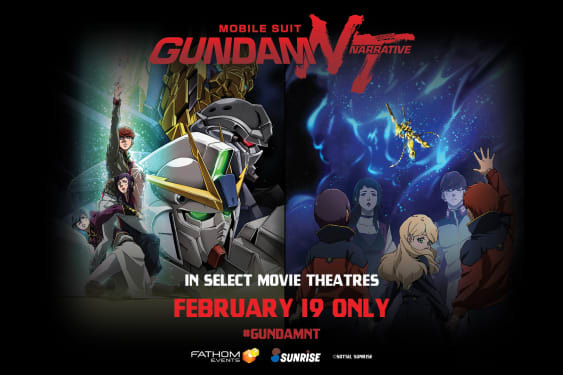
Mobile Suit Gundam Narrative - One Night Movie Premiere


If you told me ten years ago that I would be able to regularly watch anime movies on the big screen in theatres I would have surely not believed you. Besides maybe a few Pokemon movies or an occasional film in some mega franchise I don’t particularly care for such as Naruto, the prospect would probably seem alien to me even. So it’s funny how times have changed and how anime screenings in theatres is becoming increasingly more common in North America. Just last month I was able to watch the phenomenal Dragon Ball Super Broly film in a packed theatre with a ton of other nerds and it was a delightful experience. Before that I got to see the fun anime version of Die Hard known as My Hero Academia: Two Heroes, and before that a love letter to Go Nagai known as Mazinger Z Infinity! Now only a month after Broly I get to watch an honest-to-God Mobile Suit Gundam motion picture in a theatre too? I feel like the luckiest guy alive. 

If I am being honest, I actually hate going to the cinema most of the time, and spent many years avoiding doing just that. I was always the type of person that was happy enough to rent a movie once it released on DVD/BD and that was the extent I would need out of cinema at large. The only exception I started to make was when Disney purchased Star Wars, and that was more out of fear that ravenous fans online couldn’t keep their mouths shut than it was about anything else. Over the years however I started to develop a greater appreciation towards movie theatres at large and a lot of that has to probably do with anime. As I began to become a serious collector of anime and made the transition from my old DVDs to crisper BDs I realized I was at the point where as a fan I wanted the most out of my all time favorite movies--because these were not just my favorite anime movies but my actual favorite movies, and that’s when I realized I truly wish I could have seen them the way they were meant to be; on the big screen, with an insanely powerful surround sound system, wth fans all gathered around cheering at the best moments. I will probably never get this experience for Akira, or Galaxy Express 999, or the many other films that mean the world to me now, but I can get the experience for future movies, so I don’t want to miss out ever again. 


Gundam is one of my favorite franchises from my childhood. As a young kid I fell in love with the amazing robot designs and was blown away at the prospect of an anime that just felt so different from DBZ, which besides Pokemon was probably my only real understanding of anime at that age. As a teen and young adult especially the franchise became increasingly important to me and left a lasting impression on my psyche. I can’t tell you my favorite Gundam series nowadays because the answer will probably be different every time. Maybe I’ll say the original Mobile Suit Gundam, warts and all, it’s everything I love about anime from the 1970’s and to this day I still love the original Ocean Group dub from Canada. This dub while wooden and showing its age terribly will forever be etched in my mind as the definitive voices for most of the Universal Century characters despite Shuichi Ikeda butterly smooth, ecstasy inducing voice in most of the Japanese series. Maybe I’ll say Zeta Gundam as Kamile was a character my younger self identified a lot with and the series as a whole left a very strong impression on me. Maybe I’ll say Turn A Gundam, a beautiful psychedelic series that displays some of the best writing from series creator Tomino. 

So yes, having a chance to see any Gundam film in theatres was something I couldn’t miss. Even if said film ended up just okay it wouldn't matter, as not in my wildest dreams did I actually think I would get this opportunity. I figured the closest I would ever be to seeing Gundam on the big screen would be if I happened to be in Japan for some reason around the time a new Gundam OVA or film was being screened. When Gundam NT tickets went on sale for North America I bought them the day online orders were opened and was even the first person to buy a seat at the theatre (thanks to reserved seating I could see nobody else had bought a seat yet). It didn’t matter to me that I had to drive 45 minutes to the cinema, nor did it matter to me that I honestly knew nothing about Gundam NT, I just wanted to experience Gundam this way at least once in my life. And so last night I made the trek across the city and finally got to see Gundam like I never have. Now I have decided I want to share some of my thoughts and impressions about it. This won’t be a formal review, nor is it meant to be, as more or less I’m just exposting some of my thoughts, off the cuff.


First a little background information. Sunrise’s current "UC NexT 0100" project that tackles the next century of Gundam’s UC (Universal Century) timeline as well as their ambitious promise to deliver a new theatrical Gundam film every 1-2 years from 2018 onward is something to behold, so it’s no big surprise to me that the first film to kick off both of these initiative would be a sequel to the highly acclaimed Gundam Unicorn OVA series. Saying Sunrise is kind of on a Unicorn kick right now would be an understatement after all. I actually don’t mind this so much however like a lot of people seem to, as Unicorn deserves all the praise it got and there is no two-ways about it being a pivotal factor behind Sunrise’s returning commitment to the UC timeline again after releasing nothing major in it for nearly a decade. Gundam Narrative serving as a sequel to Gundam Unicorn is something I am totally neutral about. 

My greater concern going into the Gundam Narrative film was more that Gundam and films have a pretty rocky history. Honestly most Gundam movies tend to be more on the awful side. If I had to rate all the ones I’ve seen I would probably only say Gundam Thunderbolt: December Sky and Gundam Thunderbolt: Bandit Flower are fantastic, the original Mobile Suit Gundam film trilogy is an excellent compilation movie series and a good enough replacement for its own television version, the Zeta New Translation films are incredibly disappointing and omit too much, Char’s Counterattack is a hot mess that barely makes a lick of sense, Gundam F91 would have been a fantastic TV show but as a movie it makes me sad, A Wakening of the Trailblazer is okay but also undone by its own weirdness, Endless Waltz is what you would expect out of Wing, the Turn A compilation movies are pointless, and G-Savior sure was … a thing that exist. 


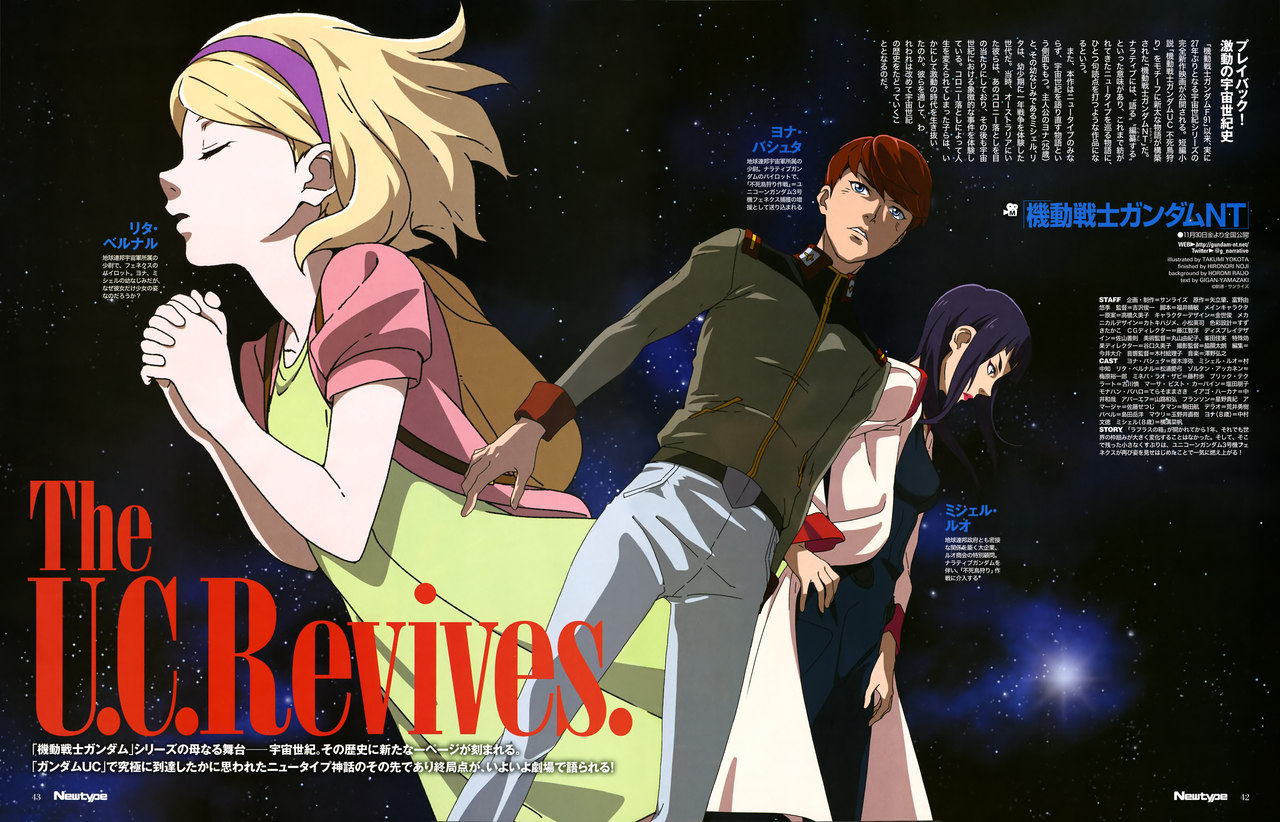
Well I am happy to say Gundam Narrative is among the rare films for the franchise that I thoroughly enjoyed from start to finish! A lot of this has to do with the scale being relatively small versus the usual scale in Gundam films that are way too big for their own good. Narrative’s laser focus on chasing after the missing Unit 03, the Golden Phoenix sibling to the two Unicorn and Banshee units we’ve seen in the previous Gundam Unicorn series allows it to tell a story largely separated from politics and the world at large--and let’s the characters become the main focal point of the film like any good movie should. 

This aspect alone is missing from so many other Gundam films and is partly why so many fail at being a good viewing experience. I’d say the few that do find that focus, mainly the Thunderbolt series of films and the original trilogy of movies made from the 1979 TV series are the best in the franchise’s filmography. A ton of other Gundam films tend to be bloated as well with rather boring middle sections, so the brisk fast pace of this 90 or so minute runtime for Narrative was a welcome relief. There are some awkward cuts to the film sure, but honestly I felt this beat sitting in the theatre for two and a half hours bored at the long winded middle section that goes nowhere like some previous Gundam films are especially guilty of. This was just enough time to tell a story of this scope properly. Of course the characters and scope of the story isn't enough to carry an entire film so the fantastic soundtrack from returning Unicorn composer Hiroyuki Sawano helped to sell a lot of scenes in the film as well.


The biggest factor that made Narrative for me however had to the film’s focus on the more metaphysical aspects of Newtypes. Despite my disliking of a lot of Char’s Counterattack I still find the more psychedelic (so to say) aspects of it to be fascinating, just as I always have when such spiritual topics have shown up in prior Gundam works by Tomino and the many teams at Sunrise. While far from perfect I always enjoyed this kind of kooky spiritualism to the Gundam universe, a sort of new age 80’s science fiction interpretation of the soul would be the best way I can describe it but there’s no real way for me to do it justice nor to make it not sound ridiculous. Since Tomino has left a lot of Universal Century Gundam series have focused more on everyday soldiers instead and not so much on Newtypes, the future evolution of mankind, and the soul. In fact I always felt Sunrise somewhat shied away from a lot of these aspect to Gundam since then, so when we got to see this aspect return near the very end of Gundam Unicorn it was a nice treat to me personally. Having it permeate almost the entire runtime of Narrative’s story had me over the moon. A lot of people disagree, and more power to them, but I just can’t get enough out of the spiritual aspects seen in Narrative. 

Gundam Narrative being a modern UC timeline production means it of course has references and lore connections to a ton of other classic Gundam series and moments. I really enjoyed most them even if they were just silly fan service moments. I love that we got to see the famous Colony Drop drawn with modern day high budget animation and it wasn’t just reused old footage. Getting to see clips of the Psycho Gundam ravage Hong Kong City was a joy on the big screen even if it lasted only about 10 seconds. I loved that we got to hear some of Char’s Dakar speech again in Narrative--this gave us an opportunity to hear Keith Silverstein, the modern English voice of Char since 2010 handle this legendary speech of his from Zeta Gundam. Speaking of the English dub my favorite performances were definitely Griffin Puatu’s portrayal of the protagonist Jona Basta that had to carry a lot of the emotional weight of the film and Stefan Martello’s portrayal of the off-the-walls insane Zoltan Akkanen who was just a pure fun villian that ate up every scene he was in. The Narrative Gundam itself being a reworked prototype of Amuro’s Nu Gundam from Char’s Counterattack 4 years ago was also a fun way to fit another Gundam into this time frame and I love it gave us such a classic looking Gundam in the Unicorn era of the franchise. 


I had almost zero expectations for Gundam Narrative, and all I really wanted was the big screen experience for Gundam. As someone that loves the psychedelic spiritual aspect of Tomino’s old works, and someone with zero expectations that a Gundam movie can really be all that good anyways I walked away from that theatre last night loving what I saw. Gundam Narrative has me personally excited for the future of Gundam films, especially if it means we may see more theatrical screenings in North America for said films. This is probably not a film for everyone, and is definitely heavy on both your love of Gundam Unicorn and your love of some of the craziest stuff Tomino would whip out in his heyday of working on the franchise, but if you’re like me I think this one will be a lot of fun, even off the big screen.

Feb 14, 2019

Valentine’s Chocolates and Glass Masks


The romance genre in anime is a little weird, and honestly on the whole the majority of the genre in anime is probably a bit too slow for its own good. “Will they or won’t they” is something most romantic fiction is guilty of, but I think you’d be hard press to come across 150 episode TV series dedicated solely to that premise anywhere else. And this has nothing on the pure silliness that can come with the genre; hand holding, indirect kisses, masked secret admirers, all that good stuff. Really, I’m not here to trash talk romantic anime though, but as I sat down and tried to think about writing a Valentine's Day blog post I just couldn't help but think to myself how romance anime might be the hardest to explain to anyone not in the fandom. I mean, I think I’d have an easier time explaining the plot of any given saga in DBZ than I would explaining “Notice me, senpai” to somebody.

You know what though, I kind of ironically enjoy all of this. Yeah, pure romance anime can be cheesy, but it’s just the right amount cheese that it’s like, c’mon, how can you not enjoy this? Perhaps the worst (or best!) offender of this are older shoujo titles where they can seem almost downright like a soap opera at times. Shows like these are just so full of bizarre, off-the-walls, and over-the-top melodrama that they manage to suck me completely in. They’re heartbreaking, they’re engaging, and the times when they fail at being those things they are hilarious. 

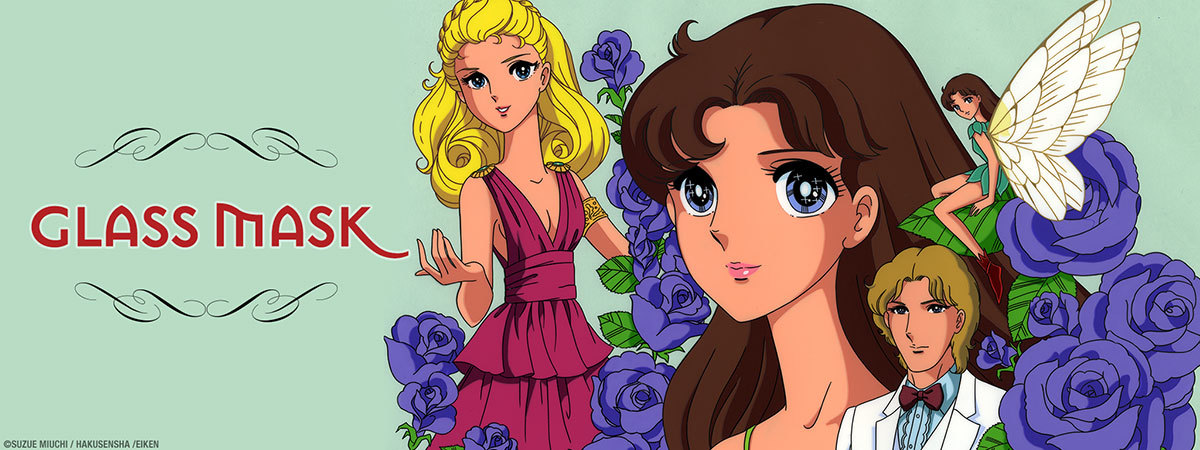
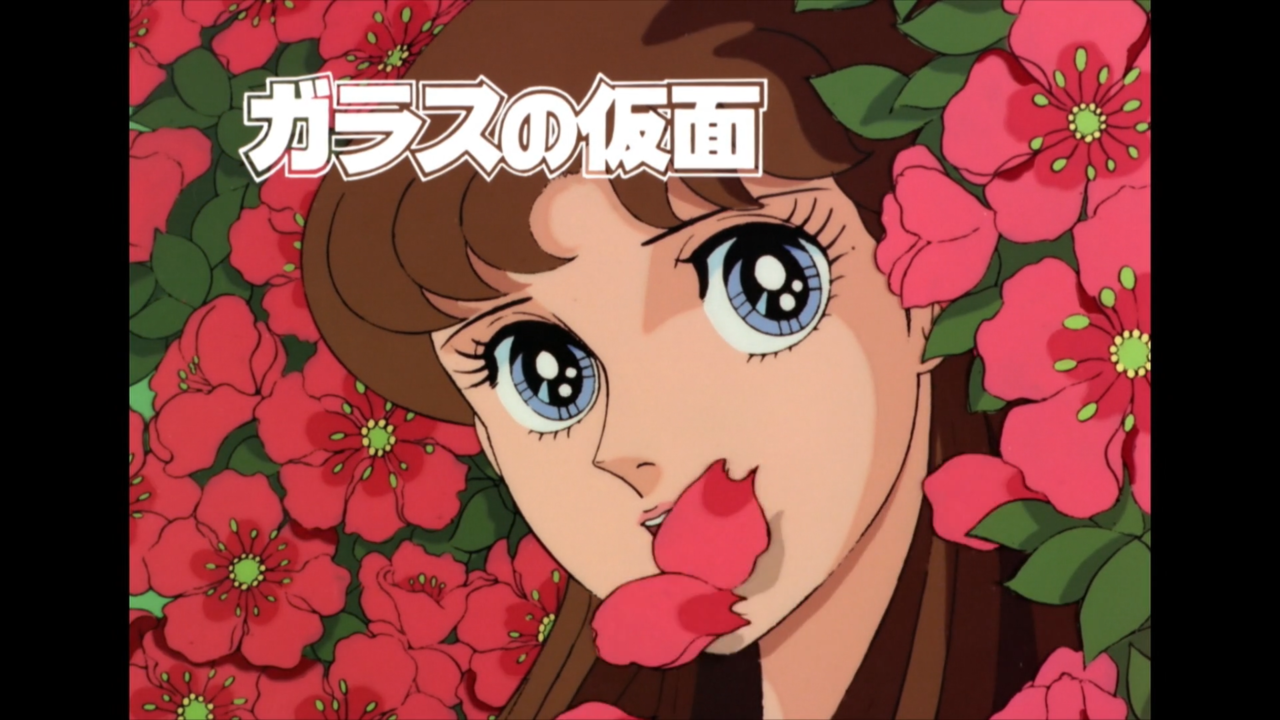
My most recent experience with an older shoujo title like this would have to be studio Eiken’s 1984 adaptation of Glass Mask. Now Glass Mask (or Glass no Kamen as it is known by some) is a manga that started life in 1976 and to this day has yet to be finished, with the manga creator Suzue Miuchi stating she would like to finish it soon, but hasn't quite figured out when that will be (move over Hunter x Hunter fans). Having been one of the earlier shoujo titles starting back in the mid-70’s the series is full to the brim with pretty much every cliche and trope you can think of for shoujo anime, and to a modern audience it can often be almost hilarious at times to sit through. It is important to remember that for its time Glass Mask was a trend-setter and arguably if not the creator than certainly the reason why a lot of these cliches became cliches in the first place. Over the years Glass Mask has received its fair share of adaptations and even parodies, and currently has 3 different animes as well as a live action drama series and real life stage plays based on it. I heard the most recent anime, the 2005 TMS adaptation of Glass Mask, does a pretty great job at modernizing several aspects of the series, but unfortunately I have yet to watch that to weigh in so all I can say is that I was inundated with more cliches than I could count and laughed a ton while watching the 1984 series and I loved every minute of it. 


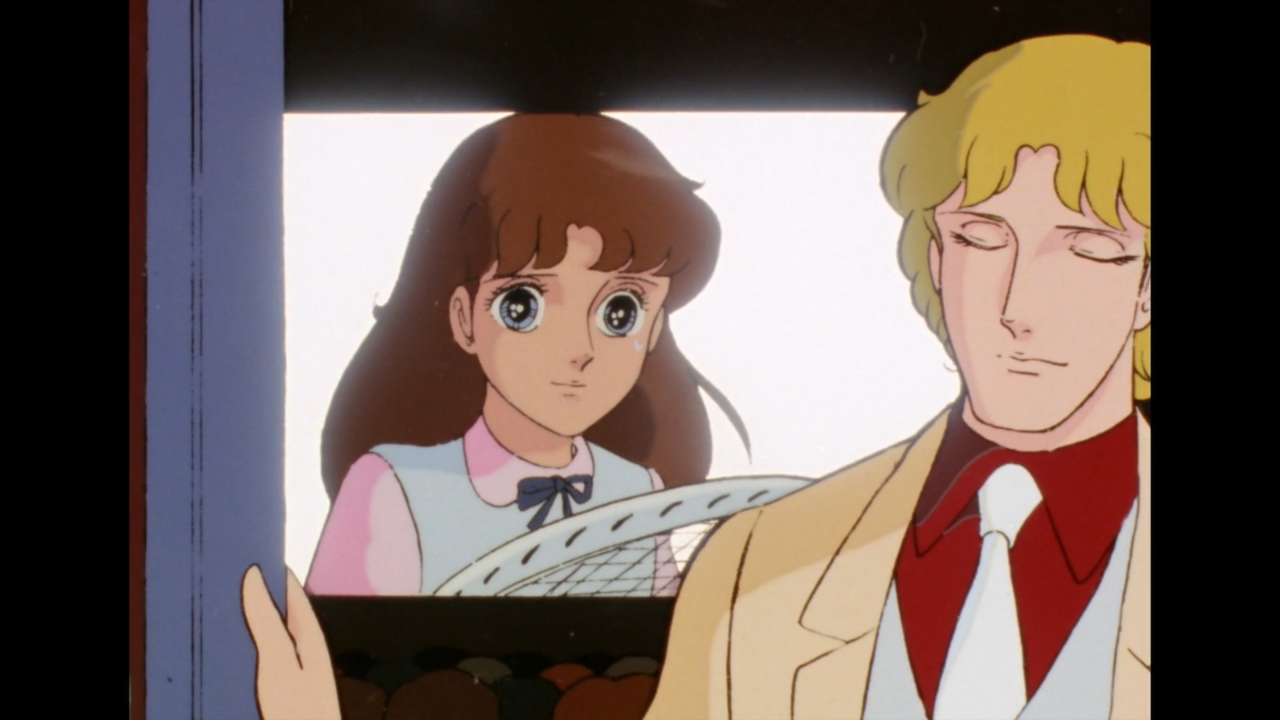
Glass Mask is the story of a young 13 year old girl Maya Kitajima, who has a dream to be a great theatre actress. Unfortunately for Maya she’s from a very poor family, and even more unfortunately for her, she is incredibly average looking with no flair--and don’t worry, the anime will remind you of that fact countless times every episode. Despite her damnable curse of “just looking kind of average” Maya will stop at nothing to pursue her dream and eventually runs away from home after getting a scholarship for an acting school. There, the enigmatic Chigusa Tsukikage notices Maya’s talents and takes her on as her protege. Soon, Maya learns that her mentor Tsukikage was once a legendary actress thought to be truly one of the all time greats who due to a tragic Phantom of the Opera style accident had her face hideously scarred and retreated out of the spotlight. 

Tsukikage is looking to pass on her talents to the future generation and eventually pass on her greatest possession, the rights to the elusive Crimson Goddess play--a supposed legendary masterpiece that has not been seen by anyone in decades; not since Tsukikage’s career ruining accident. For some reason the director and creator of the the Crimson Goddess play saw it fit to beseech all the rights to his masterpiece to Tsukikage and thus nobody else has been able to produce this elusive phantom play since. It won’t be easy for Maya and the Tsukikage acting school, as media conglomerate and mega corporation Daito Entertainment will stop at nothing to get the rights to the Crimson Goddess, and isn't afraid to sabotage them at every step of the way. Perhaps Maya’s greatest rival however is the young Ayumi Himekawa, the daughter of an already famous actress who is said to be the favorite to inherit the Crimson Goddess role, and is everything Maya isn't; beautiful, rich, famous and well loved by all, and while not a student of Tsukikage she is more than willing to pass on the rights to Himekawa if Maya fails to prove herself.

It’s easy to already see the cheesiness just from me trying my best to summarize the basic plot, and we haven’t even gotten into the romances yet. Maya’s relationship with the young Yu Sakurakoji is fairly simple at first, as he helped rescue her from a feral dog and despite being in rival acting schools--one affiliated under Daito no less, he’s a pretty chill guy that enjoys spending time with her and doesn't care about all that stuff. It’s only after Maya starts to take off in her career that Sakurakoji starts to spiral into this insane inferiority complex centered around her, where he thinks she has become too good an actress for him to be around anymore and starts to give her the cold shoulder all because of his own make-believe shortcomings. It’s very odd and sudden, and the entire thing is blown out of proportions as Maya clearly does not think that and Sakurakoji eventually has to be lectured by bad boy Masumi of all people to come around again and start spending time with Maya again. Even though he eventually starts being around Maya again it isn't like the old days anymore and the gap that was created from his action still exist. 

And oh boy, don’t get me started on Masumi, he’s quite the character. Masumi Hayami is the 24 year old son of the president of Daito Entertainment and is currently running the corporation in his father’s stead. Masumi serves as both an antagonist and love interest (because of course he can be both) in the early parts of the story and is often behind some (but not all) the sabotage done to Tsukikage’s acting school. Masumi will eventually take a more reasonable approach when it comes to trying to yank the rights of the Crimson Goddess away from Tsukikage’s hands as the anime progresses, often just by having his acting school beating Tsukikage’s students in contest and the like, and it’s here where we usually see Masumi’s employees that work under him being the more underhanded characters instead of Masumi directly engaging in the conflict. 

Despite being on different sides, so to speak, Masumi catches one of Maya’s earliest performances, her role as Beth in Little Women, and falls in love with the young girl, impressed by both her potential as an actress and her fortitude for going on with the show despite suffering from a dangerously high fever and immediately being rushed to the doctors after the curtains fall. From this point on her takes the role of “Mr Purple Roses” named for the bouquet of purple roses he sends to her at every show. As her secret admirer and the first fan Maya has ever had he means a lot to her yet as his true identity of Masumi he’s an enemy that Maya cannot stand to breathe the same air as. So in short, Masumi is just your average 24 year old CEO of a mega corporation crushing on a 13 year old girl from a small acting school he is trying to ruin and also her secret admirer. Somehow Masumi is one of the best characters in the series, and is my best boy. Only in shoujo!


So far I've been having some cheap laughs at the expense of the 1984 Glass Mask anime but it’s not all like this. The over-the-top bombardment of old school shoujo cliches and the laughs I got from them may be one of the most memorable component of my viewing but there’s actually a lot more to this anime than that. When you get beyond the silly age gap romances and the flowery melodrama of young teenage love, Glass Mask is a story of artists trying to pursue their passions and dedicating their everything to them. Maya may be cursed to forever be “only average looking” but I really respect her drive to dedicate her entire life to theatre. 

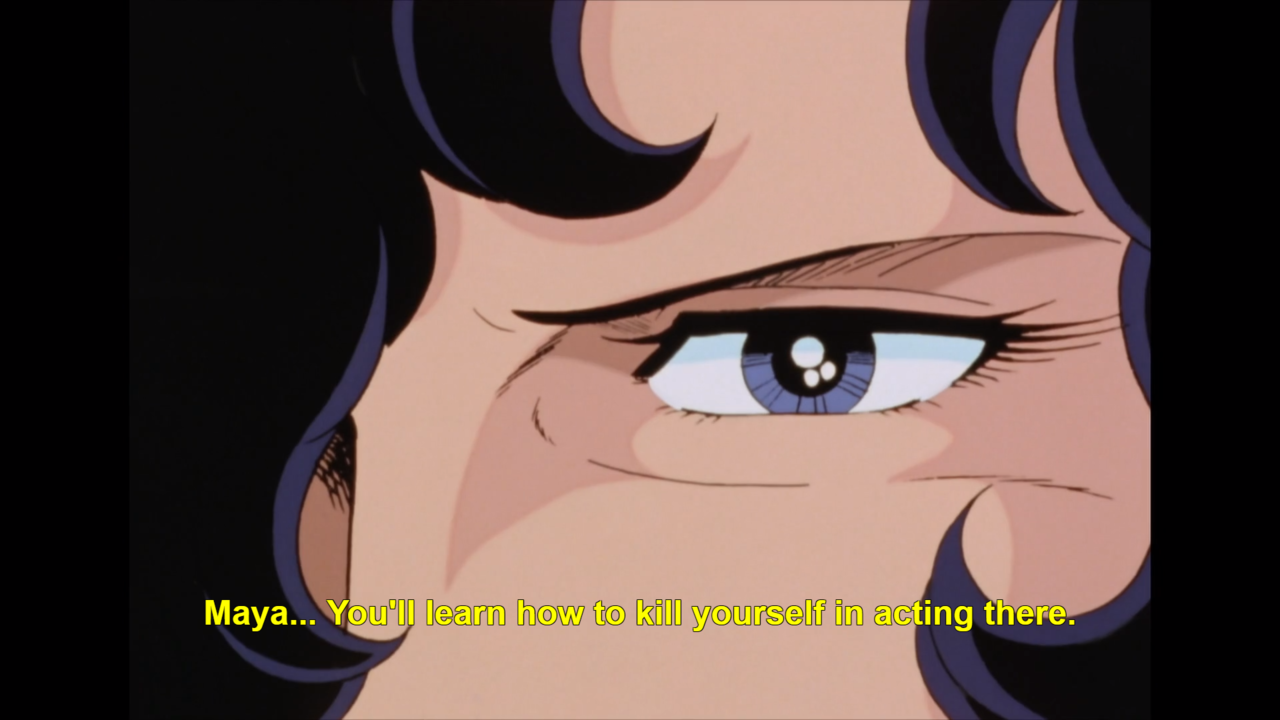
Well, that is to say, the times when she isn't acting like punching bag to the rest of the cast (Glass Mask has a tendency to make Maya into a Cinderella surrounded by tons of wicked stepsisters). When Maya is written not as a Cinderella she’s fiercely determined, and never backs down despite some straight-up abusive behavior she is put through. At times her mentor Tsukikage is absolutely savage, regularly beating Maya and putting her through some training that is definitely highly illegal, at least for today’s standards. For instance she once threw Maya in a shed and locked the door refusing to let her out until she finally understood her character she was assigned. Did I mention it was in the middle of the freezing cold winter and snowing out and Maya only had the clothes on her back for warmth? She was out there for days with no food, water, or even warmth. But don’t worry, she had her script to read and that made it all okay. Like goddamn, somebody call child protective services on this lady.


Speaking about “the art” and everyone’s passions, the more you watch the series the more it becomes obvious that the creator, Suzue Miuchi, really cares for theatre and isn't just using it as a vehicle to propel her own story. There are countless renditions of classic plays shown in Glass Mask, such as the mentioned already Little Women, The Miracle Worker, and Wuthering Heights, just to name a few. Some of these plays are presented without any changes while others may have reinterpretations made to them by the characters who are trying to give their roles a life of their own away from the original source material. Miuchi very much understands theatre and does a great job converting many famous plays into a more compressed and easily digestible form of entertainment that can be viewed on a week by week bases. The analysis characters give about the plays and other characters’ performances, the ways characters interpret their parts, and how the plays that we are privy to see in the series end up all show a deeper understanding of the medium. Watching Glass Mask is almost like taking a beginning course in theatre that covers all the classics, only with way more melodrama and over-the-top romance than you will find in your local theatre group. I hope.
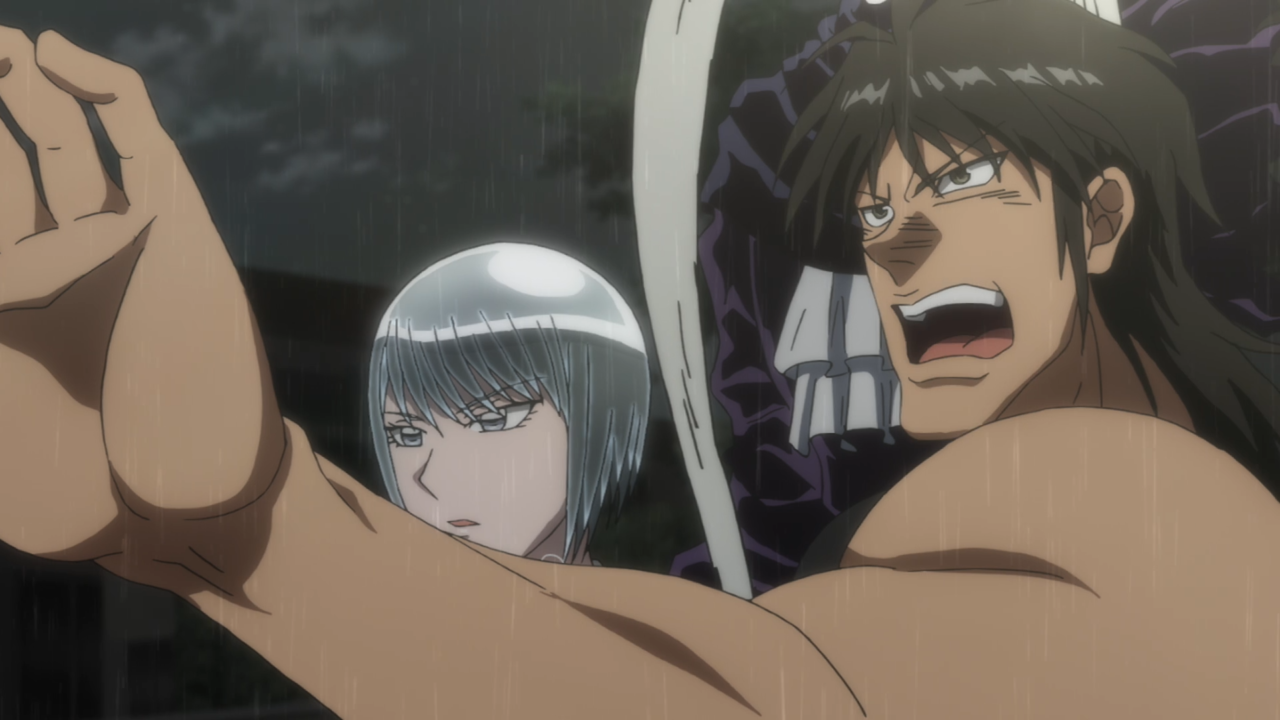
What’s the most impressive however goes beyond just Miuchi’s renditions of other classic works and instead are her own plays that she creates herself. As not only does Glass Mask use pre-existing plays it also has its own original productions that will spring up in-between the real world plays. A lot of these self created plays are very enjoyable too, and some feel way more fleshed out than they have any right to be and you often find yourself regretting that you are only privy to a small part of the performance and not able to just sit there and watch the entire play like the characters in the anime do. Maybe that’s why it shouldn't be too much of a surprise that some of the plays Miuchi has created for her manga have later been adapted into real life plays in Japanese theatres. This is probably the greatest testament to the series’ popularity right there, where its own fictional works are turned real. I can’t think of many examples of something like that happening before. 

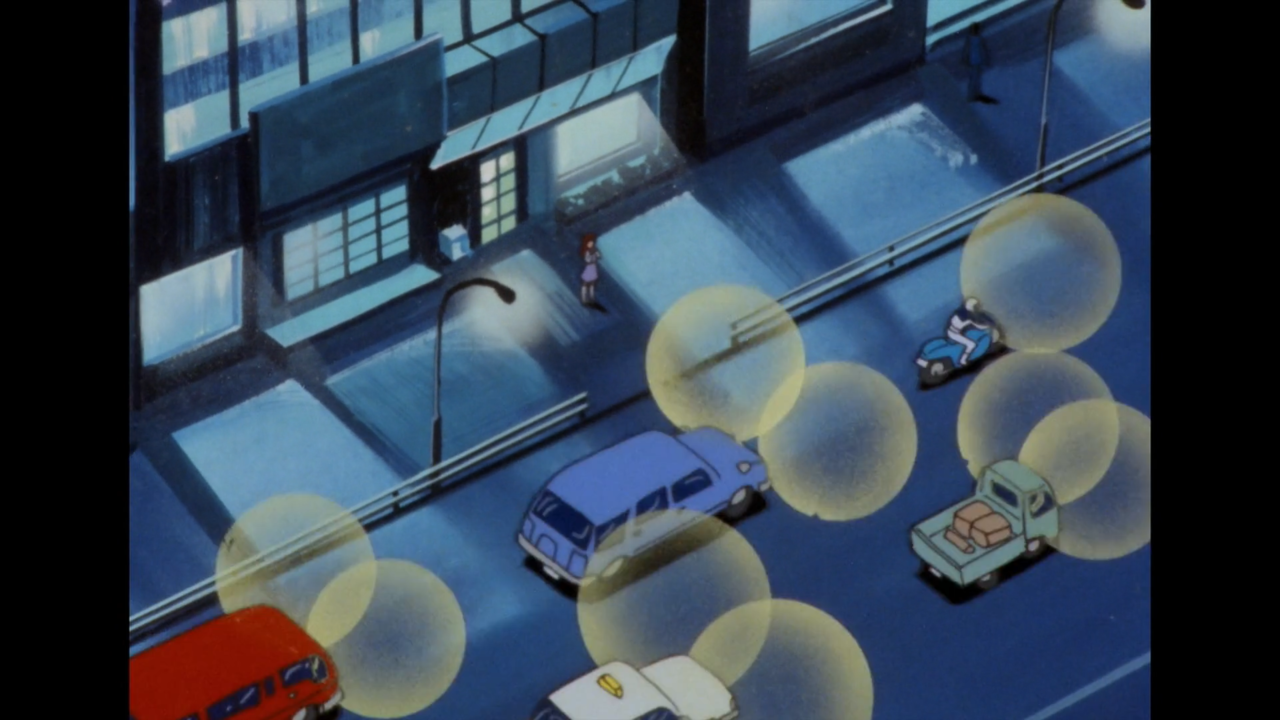
I’d be remiss not to mention the visual aspect of this series before wrapping up my thoughts on it too. While certainly no powerhouse in animation, Glass Mask 1984 goes for a more picturesque route, and does a great job with tons of beautiful still shots and intricately detailed background images. It’s a humble production but with the right use of lighting a lot of scenes can really shine (pardon the terrible pun it was an accident), especially the night shots which can be pure art. Hang it in a museum, I say. I’m almost surprised we don’t see more “aesthetic” anime blogs mining images from this series. Veteran director Gisaburo Sugii (Dororo, Touch, Osamu Tezuka’s Phoenix) leads the production with skilled marksmanship you would expect from his previous (and future) pedigree, and along with legendary animator the late Shingo Araki (Ashita no Joe, Galaxy Express 999, Saint Seiya) the series has a wonderful 80’s flair to it that just fills any retro anime fan full of nostalgia whether or not they have seen the show before. 


Studio Eiken’s 1984 Glass Mask adaptation is a short, briskly paced 22 episode series that is easy on the eyes and not hard at all to still sit through for modern audiences. It’s full of tons of laughs (both ironic and sincere) as well as tons of melodrama and over-the-top romance. Most importantly though, it’s a full of passion; lots and lots of passion. During its short episode count the series watches Maya progress as an actress and grow older, with her finishing middle school and beginning high school while also balancing full time acting jobs on the side. The ending is left open--and let’s face it the manga hasn't even ended some 35 years later still--but there’s enough forward momentum in the series to really feel like your time with the characters wasn't wasted and that they were able to accomplish something--not to mention the ending spot is a pretty decent one leaving the viewer wanting more but enjoying a satisfying conclusion to one of the more interesting story arcs adapted. Overall I think anyone who enjoys cheesy anime romance can sit down with this series and have a fun Valentine’s.

Jan 9, 2019

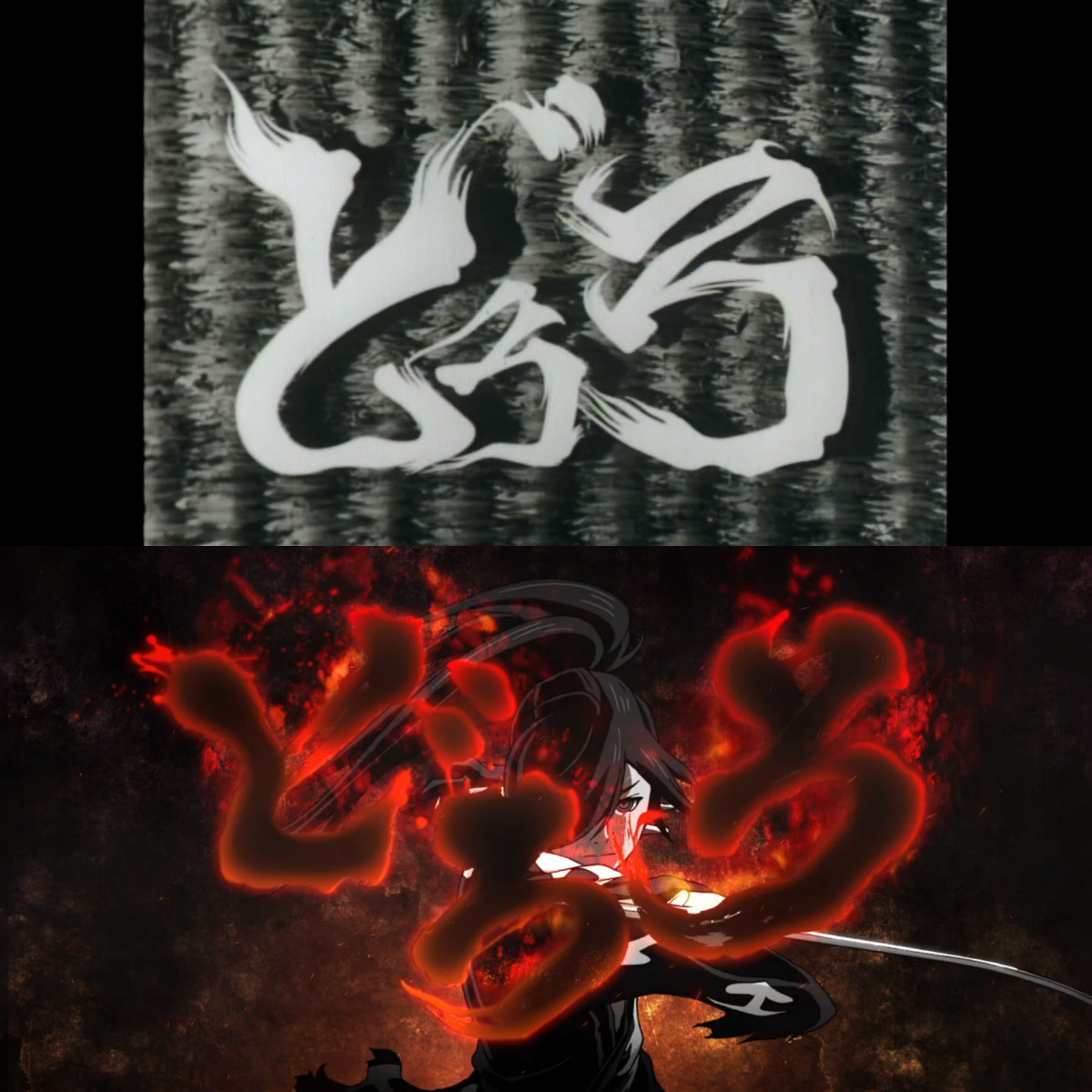
50 Years of Dororo - Mushi Pro’s Dororo 1969 vs Studio Mappa’s Dororo 2019


2019 marks the 50th anniversary of Mushi Pro’s Dororo anime adaptation, the last anime to be made solely in black and white. The 1969 original Dororo anime is a cult classic, with high accolades from the diehard community and still holds up incredibly well to this day. Yet that didn’t stop Studio Mappa from creating their own adaptation of the manga, which has finally released just this week. So the real question is, how do the two of them compare--well let’s get into it.

But first, a little background. The original Dororo manga, created by prolific manga creator Osamu Tezuka, ran in Weekly Shonen Sunday for about one year, from August 1967 to July 1968, where it then entered a hiatus for a brief period, before finally shifting to the Monthly Adventure King magazine in 1969 where it was serialized for about 6 months (May to October ‘69) and finally “concluded”. I say concluded but the manga mostly just abruptly stops before the characters accomplish any of their own goals, and things are more or less just left open in case Tezuka ever wanted to come back to the series (he didn't). Despite this Dororo has remained to be an incredibly beloved property by Tezuka and seen its fair shares of retellings and adaptations from video games to live action films, and of course to anime.

So now let’s talk anime. The original 1969 adaptation of Dororo was created by Mushi Pro, Tezuka’s own animation studio that he started half a decade back in 1963, and as said above was the last anime to be created solely in black and white. By this point in time color TVs were finally becoming widespread in Japan, and most anime have already started to be created in color. This was not an easy process, and was more time consuming for the production, which is why the decision was made by Mushi Pro to stick to the work pipeline they had and produce Dororo in black and white, a decision that really went on to define the entire series. Mushi Pro's Dororo has a very crisp look, with some great animation for its era, but beyond manages some incredibly terrifying and equally breathtaking moments because of its sharp drawings mixed with the black and white aesthetic. There’s just something about black and white, the atmosphere it creates is otherworldly, just ask any movie buff and they’ll tell you the effects it has on the horror genre is undeniable. I think these late black and white 1960 era anime hold up so incredibly well, and may in fact be even creepier nowadays (the 1968 GeGeGe no Kitaro comes to mind).


Dororo (1969) episode 4: The Scroll of Bandai Part 2
Time marches on however, and after 50 years it’s time for another studio to take a swing at Dororo. Mappa is a small animation studio established in 2011, founded by Masao Maruyama, producer and co-founder of Madhouse, who left Madhouse to pursue his own passions and took some staff with him. Maruyama would later leave Mappa in 2016 unfortunately, but the studio to this day has still been producing hits since. The staff behind their current Dororo adaptation is helmed by Kazuhiro Furuhashi as director, Satoshi Iwataki as character designer, Yasuko Kobayashi in charge of scripts, and Yoshihiro Ike composing the music. Background animation is handled by Studio Pablo. Dororo is produced by Twin Engine, a production company with its main focus being the creators of the medium. Founded by Kouji Yamamoto, Twin Engine wishes to let young artist focus on creating anime, ignoring popular trends instead pursuing only the art of the medium; often commissioning work from studios to keep them financially afloat. Dororo, like a large majority of Twin Engine produced series, streams worldwide on Amazon Prime.

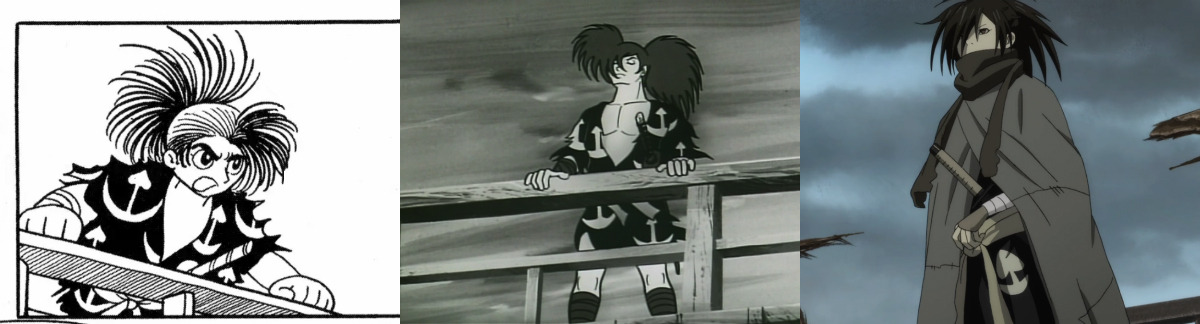
My final aside before diving into some thoughts on how both adaptations compare is that when it comes to adapting Tezuka’s iconic designs to the form of animation there are often changes made. The more Disney-esque look of his drawings can be hard to pull off for action animation, and well, giant noses, and bushy mustaches are well and good, but when you’re trying to sell hideous monsters chomping people into bits, maybe they are not that fitting for this story. That’s why both the 1969 Mushi Pro and 2019 Mappa series have their own takes on the design of the characters. Mushi Pro sorta goes for making protagonist Hyakkimaru more buff, and adult looking, whereas Mappa makes their Hyakkimaru slim and more ikemen. I think both approaches work fine for the story at hand, and are interesting time capsules of themselves for their own eras. 

So let’s compare the first episode of both series!


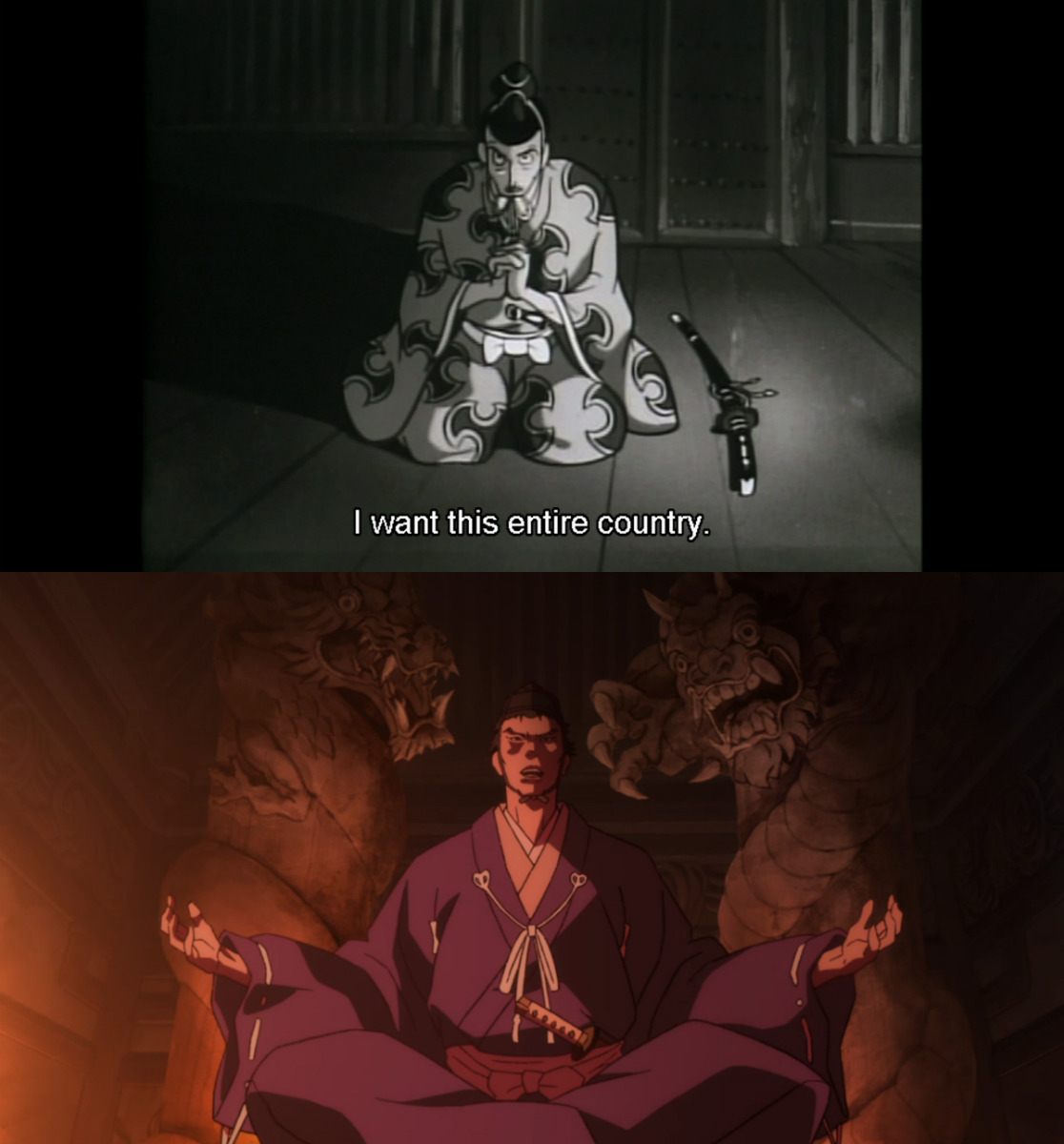
Both episodes start in a similar fashion, with Feudal Lord Daigo Kagmitsu making a deal to 48 Demons and sacrificing his then unborn son in the process. However even this early on we can see differences between the two adaptations. 

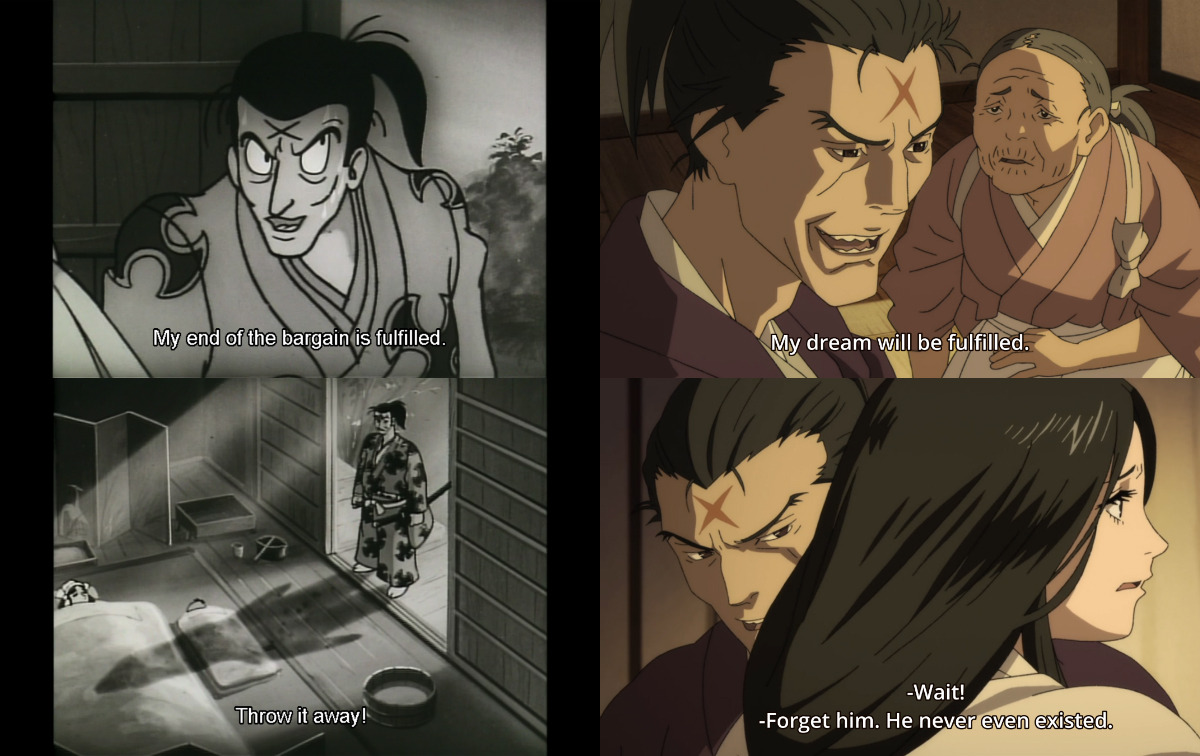
In the 1969 Mushi Pro version Daigo willingly offers up his own son to the demons, and does so for power, asking them to grant him all of Japan under his rule, whereas in the 2019 Mappa version Daigo only offers the demons anything they want in return, never directly giving them his own son, and asks for the demons to give him the power and prestige he will need to rule over Japan. 

At first I felt that Mappa may have made Daigo a bit more sympathetic, him seemingly asking for his own province to be granted protection from disease, famine, and war is certainly something we haven’t seen out of the character, but were perks he does enjoy later in the story regardless. As I ruminated on it however, I realized it’s more of an attempt to round out his character and add some extra depth to him. Sure those may have been great things for a Feudal Lord to ask for, but Daigo really only cares about one thing, and that’s ruling Japan; this has yet to change. Daigo still has no qualms about his own son Hyakkimaru being born a hideous freak and still throws away the newborn baby to die in some river while yelling at his wife to make another one to replace it. 

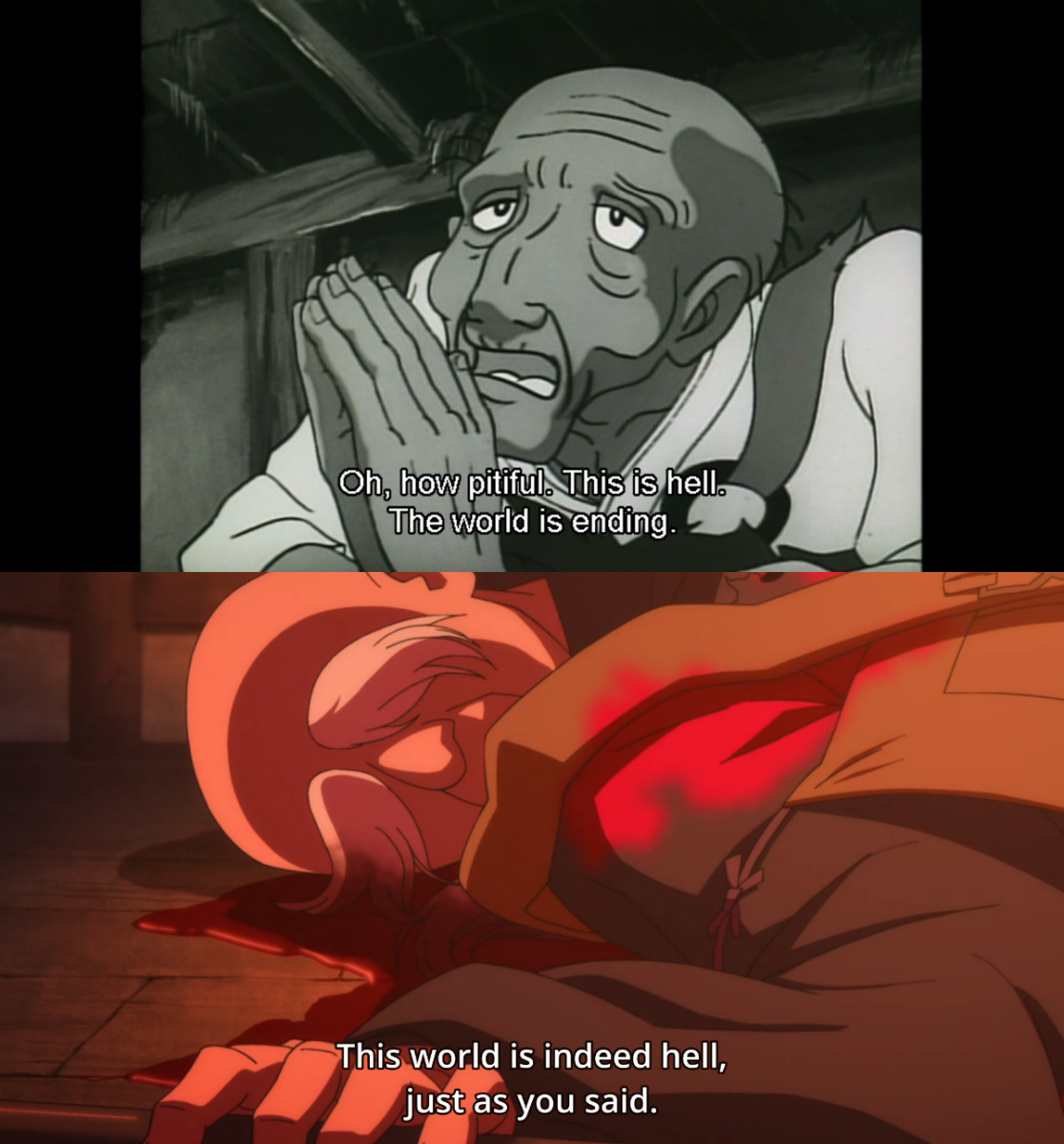
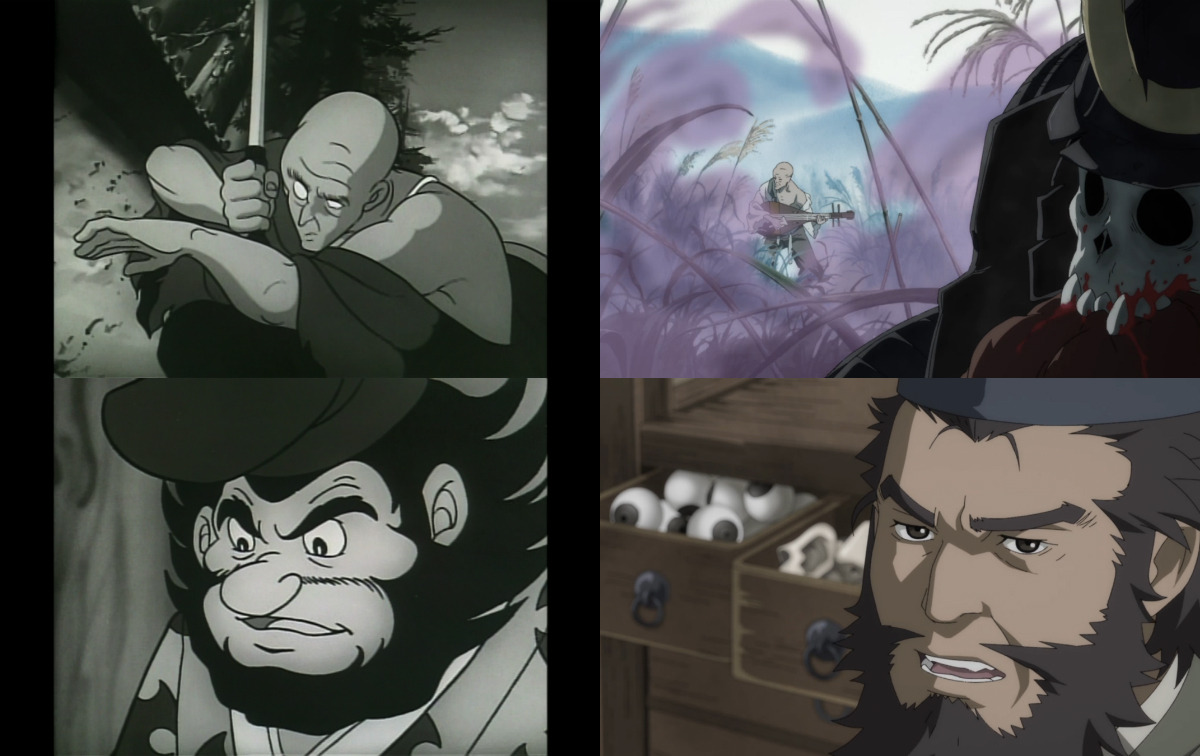
One Buddhist monk starves to death while bemoaning the state of Japan
while another is slain and bemoans the current state of affairs in Japan.
Then there’s Daigo killing a Buddhist monk. This scene does not exist in the 1969 Mushi Pro version (but Daigo does murder the monk albeit under different circumstances in the manga) and I have quite a bit to say about that. Daigo’s conversation with this monk, again, shows him off to be a bit more well rounded. He’s still selling his soul to the devil, but we can see his own level of commitment to his ambition when talking to the monk. The monk also plays another role that mirrors Mushi Pro’s first episode. In Mushi Pro’s debut episode Dororo comes across a starving Buddhist monk that can do nothing but beg for food and pray, and eventually succumbs to his starvation and dies. Both monks remark about the horrors of the current sengoku era being like Hell on Earth, and are meant to communicate to the audience that this particular time in Japanese history is perhaps one of the cruelest.

1969 or 2019, Daigo is still a dirt-bag.
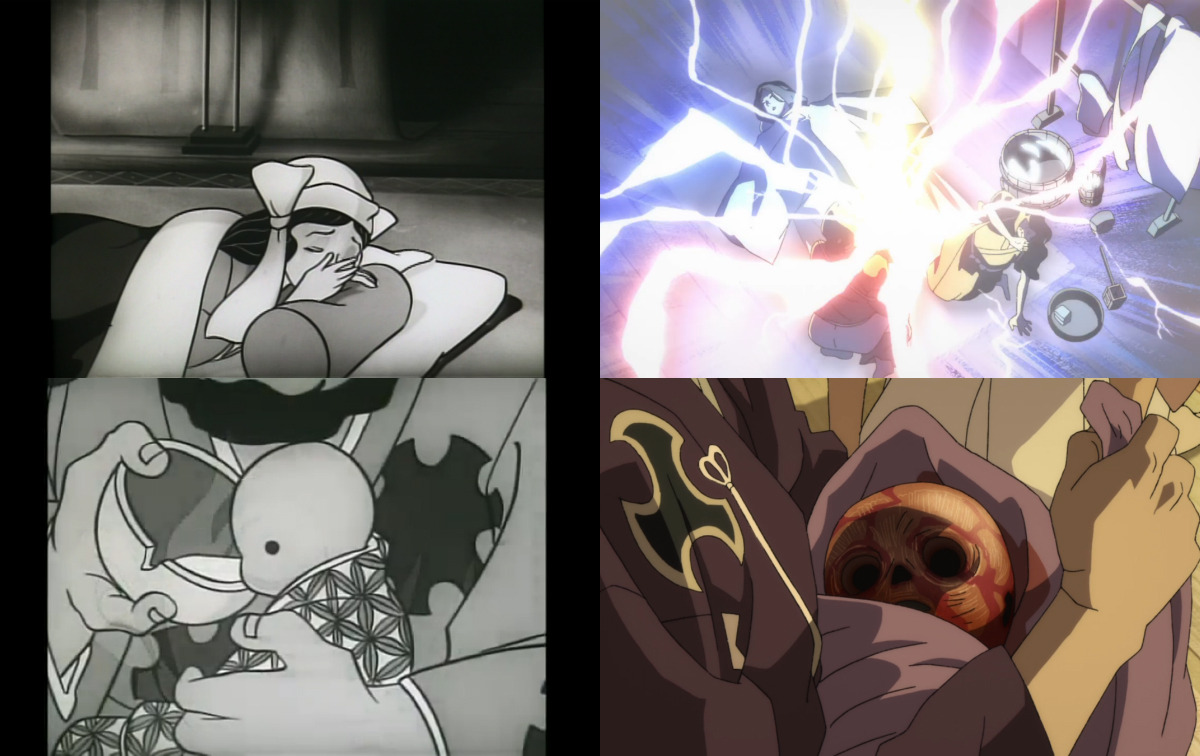
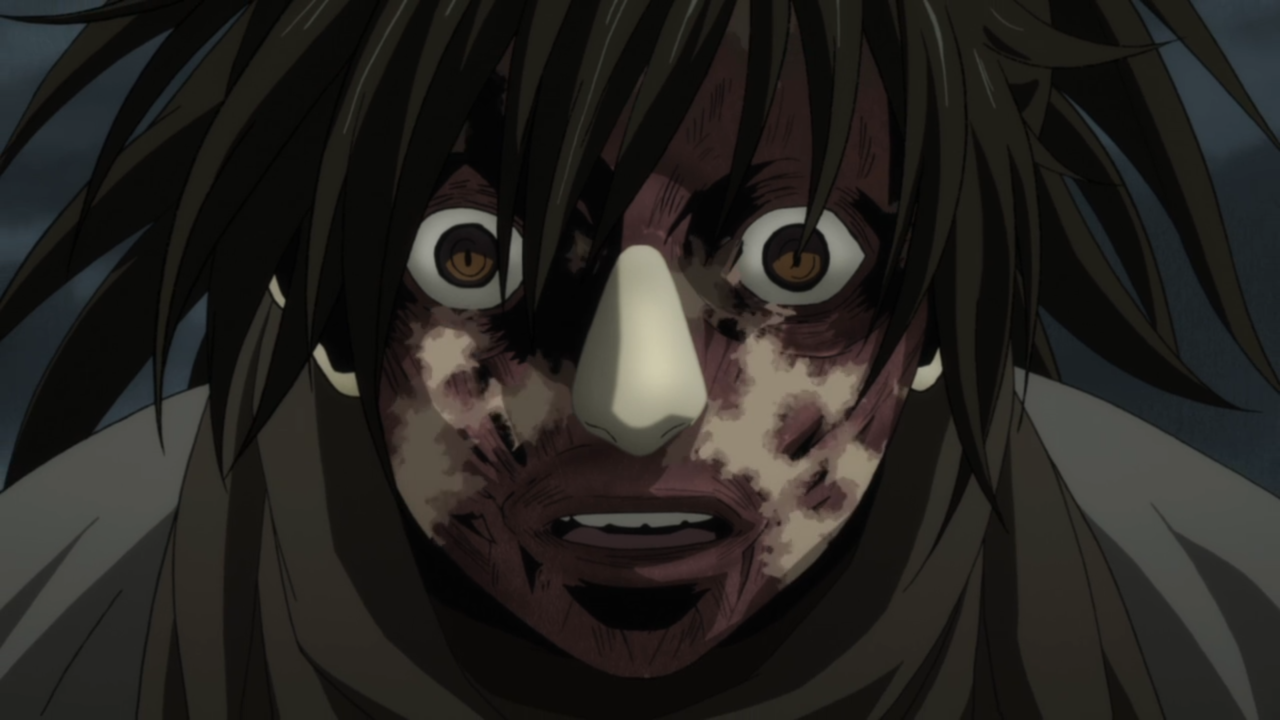
Let’s talk about Hyakkimaru’s birth as I think it’s a pretty interesting contrast between these two adaptations. In the 1969 Mushi Pro version Daigo already knows his son should be born a monster so upon seeing the hideous freak that is his baby boy, he proudly declares “My end of the bargain is fulfilled!” The demons have accepted Daigo’s offer and he can’t be happier. In the 2019 Mappa version Daigo is not aware of what the demons will take until a bolt of lighting strikes the room his wife is giving birth in. Upon seeing the baby up close (something not seen in the 1969 version until the second episode) Daigo realizes what has happened and orders the baby killed. We then get a conversation about a Buddhist statue that happened to break in the same room. The wet nurse believes it sacrificed itself in order to save the baby, giving a sorta strange implication that perhaps the deal wasn't to take 48 body parts from Hyakkimaru but to take everything from him, including his life. In fact we never really even establish if there are 48 demons, or 48 body parts missing, so the number may vary, and the kind of curse could be different. If that is true, it is certainly a unique approach to the series.

The image of baby Hyakkimaru from Mushi Pro's 1969 Dororo adaptation
is taken from the second episode as it was not shown in the first episode.
Hyakkimaru’s birth between the two versions shows how both mirror each other--we have less subtle writing but more subtle animation in the 1969 Mushi Pro adaptation, and more subtle writing but super over-the-top animation in the 2019 Mappa adaptation. I find this maybe the best way to compare these two anime entirely so far. There is no huge lightning bolt smiting the room Daigo’s wife is giving birth in, in the Mushi Pro version, instead you hear the mother scream in terror upon Hyakkimaru's birth as she breaks down and cries. Daigo and his wife's expressions of horror at the baby is the only clear indication of Hyakkimaru's hideousness instead of just showing the baby like Mappa did. But The Mappa version is trying to give some more depth to its characters, and maybe even to is own world with added bits such as the Buddhist statue maybe protecting Hyakkimaru. Both adaptations seems to have reverse on what they wanted to be subtle about and what they wanted to be over-the-top about. 


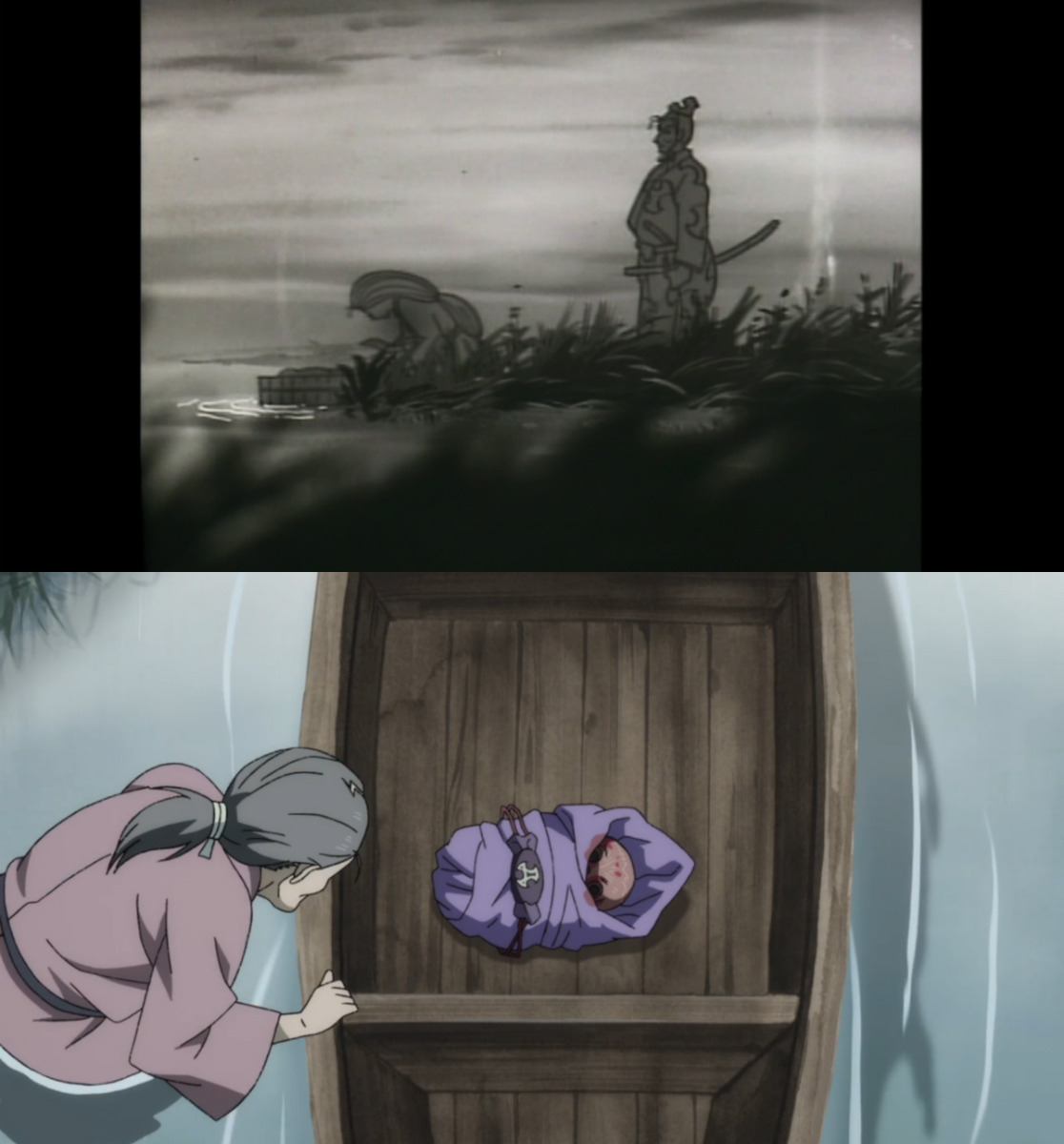
In the 1969 Mushi Pro version Daigo and his wife send Hyakkimaru down the river in a basket themselves, where as in the 2019 Mappa version Daigo orders the wet nurse to drown Hyakkimaru in the river, but she pities the baby and places him in an abandoned boat then pushes it down the stream. And then a demon shows up and murders her out of nowhere and is slain by the blind monk Zato (a character that didn't appear until Hyakkimaru narrates his past to Dororo a little later in the story). Yeah, that was a really weird addition to the story Mappa made. It’s certainly more over-the-top and gets a bit more action into an episode that amounts to basically all set-up, so there is that, I guess. Still really weird to see Zato show up like this. 

Both Zota and Jukai don't make their introduction until Hyakkimaru explains
his past to Dororo in the second episode of the 1969 Mushi Pro Dororo.
Speaking of adding in characters earlier than before, Mappa included scenes that would interrupt the episode every now and again that focus on a doctor who gives prosthetics to dead maimed warriors so they can rest in peace. These scenes did not exist in the 1969 Mushi Pro version, which didn't show Jukai until episode 2 where it tells the story of how he saved a baby in the river he found, Hyakkimaru, and gave it prosthetics. 


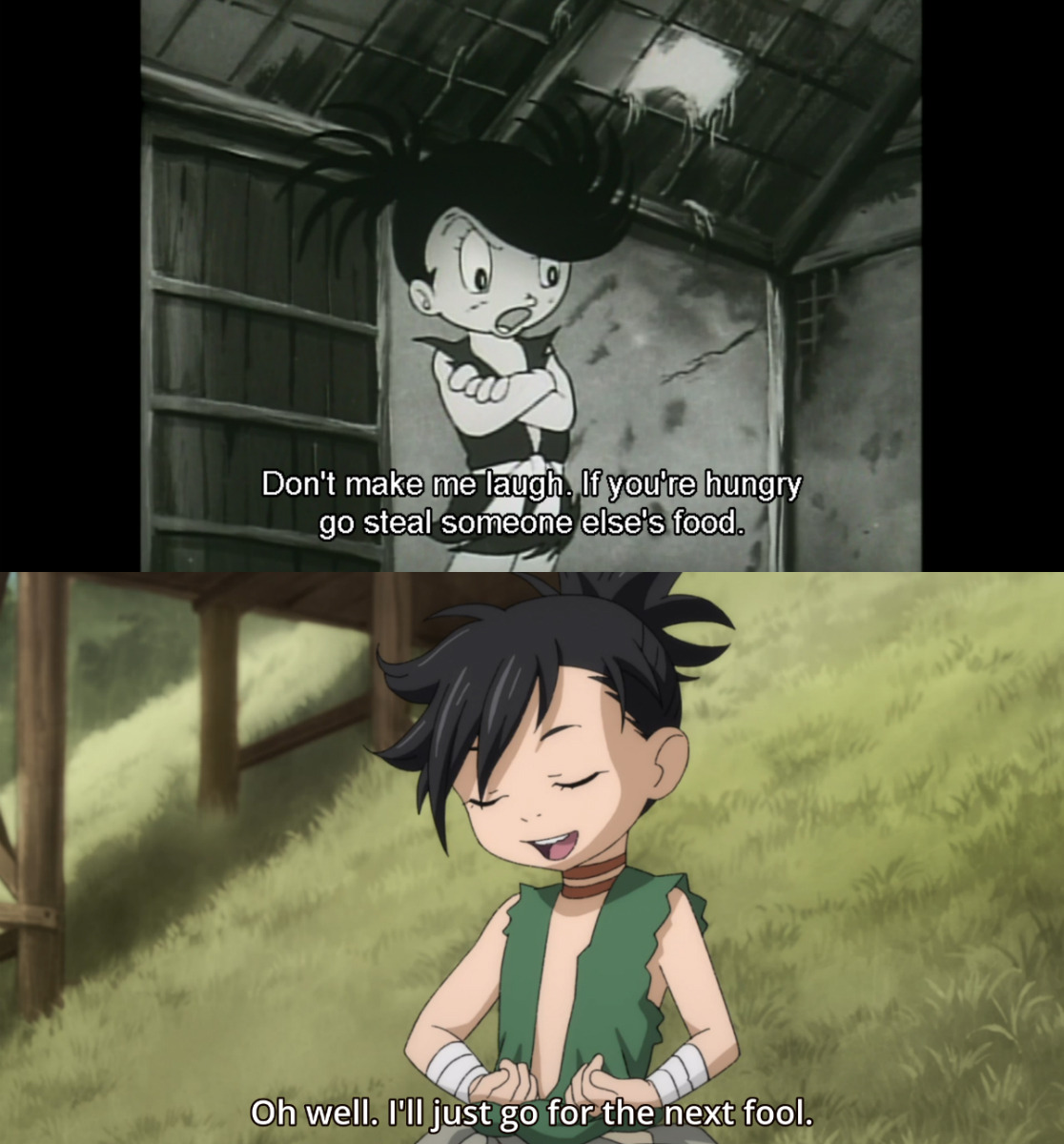
The introduction to Dororo is pretty similar in both versions, but more drawn out in the 1969 Mushi Pro adaptation. As discussed above with Daigo and the Buddhist monk, there was a scene where a starving monk begs Dororo for food before succumbing to his own starvation and dying, this was not present in the 2019 Mappa adaptation. Dororo gets more time to just do some general hijinks and mess around in town in Mushi Pro's version as well, before finally stealing food from some lowlifes and getting the crap kicked out of him by the riverbank. 

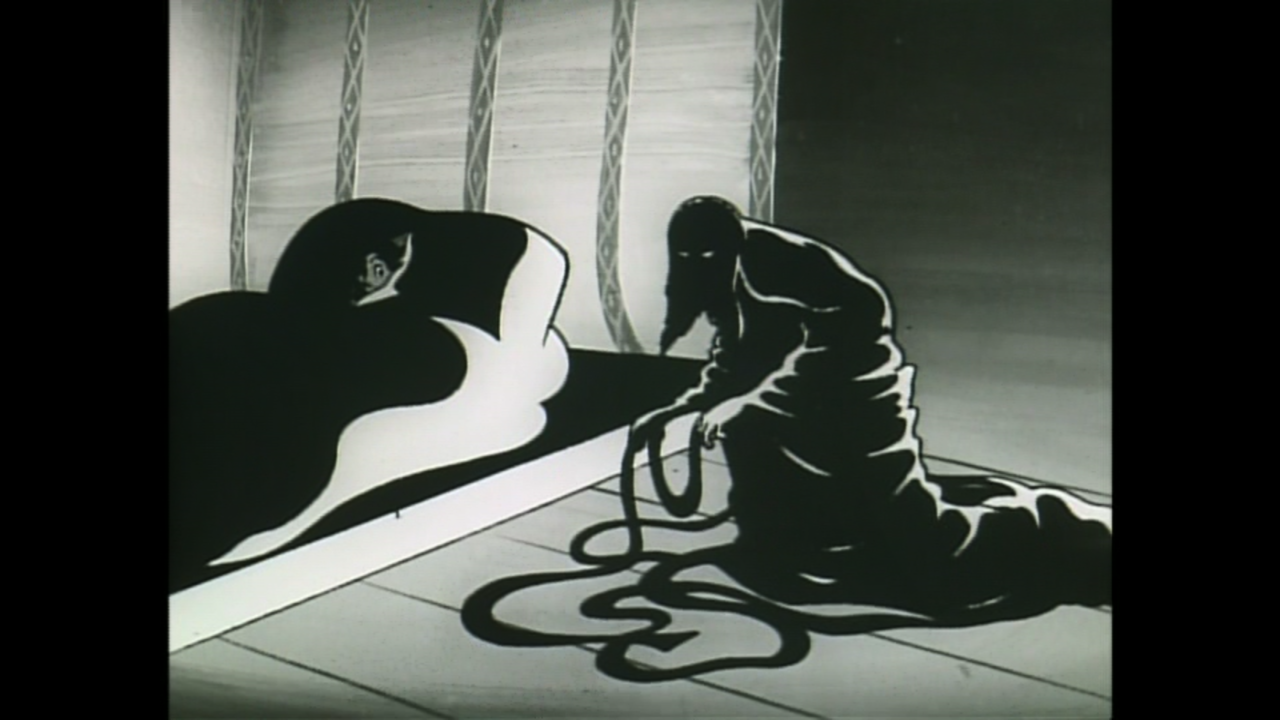
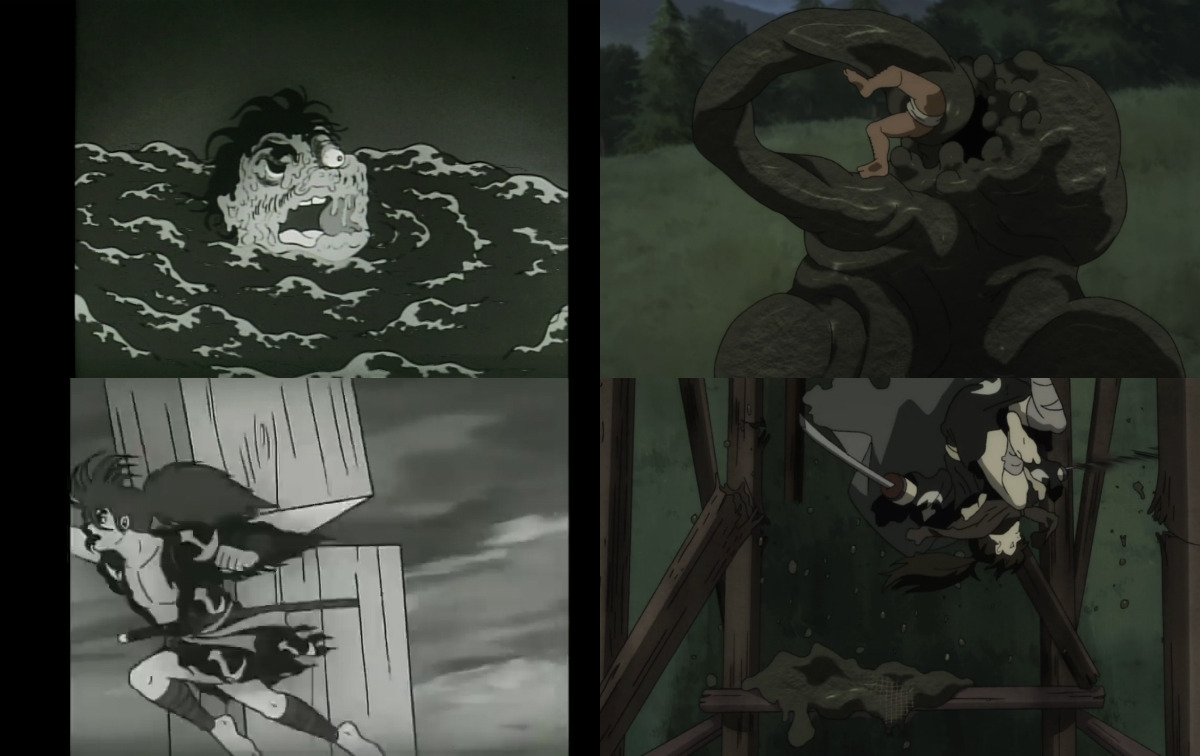
In the Mappa version instead of stealing food from lowlifes Dororo steals their cargo and tries to pawn it but is caught then beaten at the riverbank. I imagine Mappa was just trying to streamline Dororo's introduction here for time constraints so they did their best to get across that he’s a thief while also making sure he ends up at the riverbank right away. Either way both adaptations lead to this slime looking monster appearing out of a pile of garbage in the river and eating the lowlife. Mappa’s more over the top animation has the monster swinging around its arms wildly until eventually grabbing said lowlife and making a snack out of him, where Mushi Pro has it slowly slither on top of the lowlife and then melts him. Ouch, that’s kinda way more messed up. 

The lowlife gets melted by the monster in the manga too.
From this point on both adaptations are pretty much entirely the same, with just differences in animation quality being really all there is to comment on. The fight scene between Hyakkimaru and the slime in Mappa’s version is fantastic, with Hyakkimaru performing incredible acrobatics, jumping all around the bridge and slicing the whole thing up until it collapses on top of the slime killing it, where Mushi Pro … well they did their best, okay. 


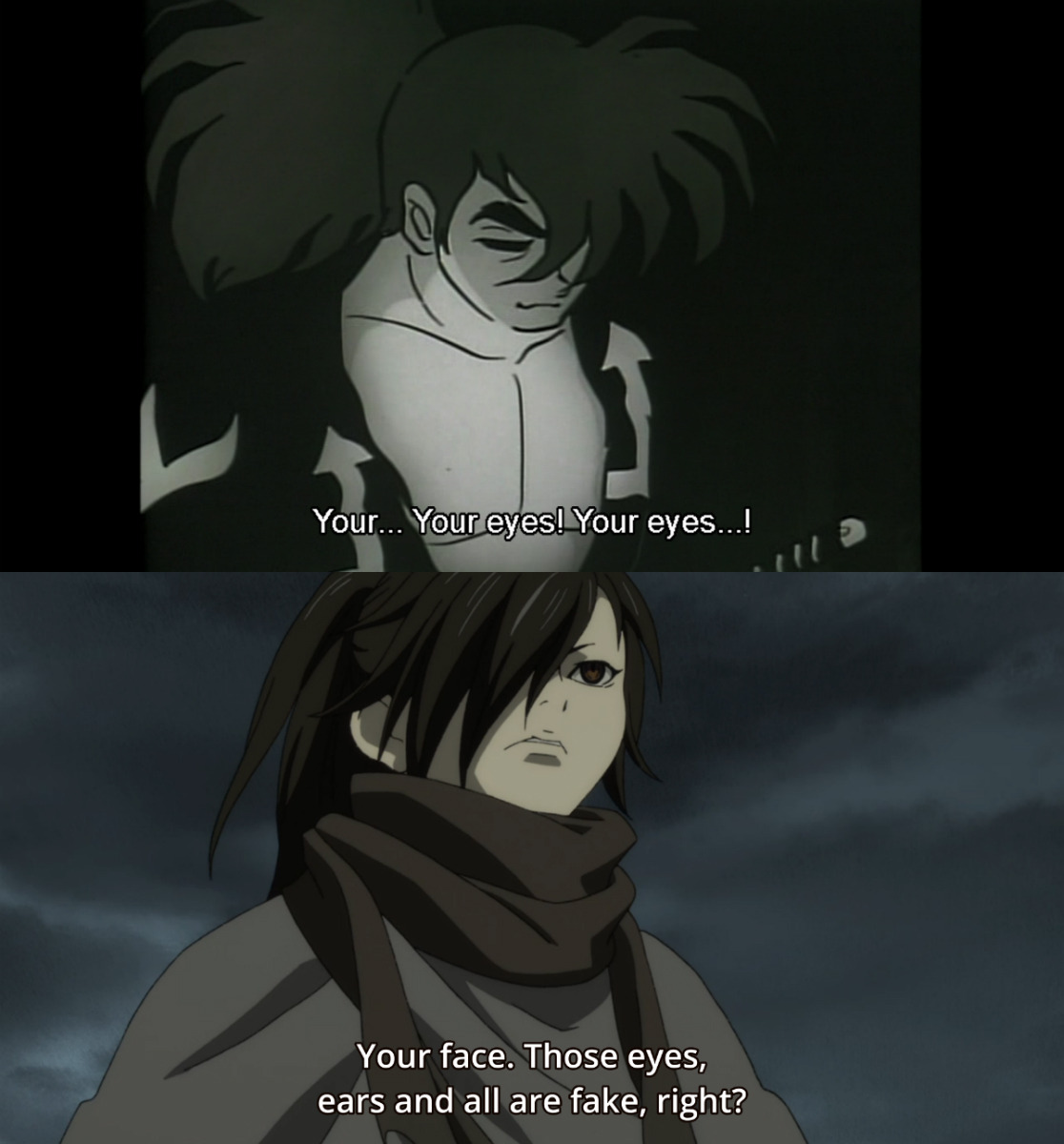
The real big difference is that Dororo seems a lot more intelligent when approaching Hyakkimaru in the 2019 Mappa version. Dororo was very quick to notice that Hyakkimaru is blind, and that his body is made up of mostly prosthetics. The 1969 Mushi Pro Dororo ends up getting terrified in the very next episode upon the realization that Hyakkimaru’s eyes are fake (he admittedly popped his glass eyes out of his head though to scare Dororo away).


The 2019 Mappa version has it that the riverbank monster was apparently one of the 48 demons Hyakkimaru needed to slay in order to regain his body parts, this one giving him back his skin. Hyakkimaru was actually born with his skin in the 1969 Mushi Pro version (as well as in the manga), and the monster was not the first demon he needed to kill but just a run-of-the-mil yokai that awarded him no regenerated body parts. Hyakkimaru actually worded it as "the dead", which have no true shape of their own and just latch onto anything, in this case the garbage in the river--thus making the slime monster we saw. Again I think Mappa was trying to kill two birds with one stone and get the audience acquainted with the series quicker since the general plot is essentially Hyakkimaru slays monster, Hyakkimaru grows back lost body part. This was a good way to streamline things, and it was with a body part that he wasn't missing before so it takes away nothing from later parts of the story.


And this is the biggest difference right here at the end of the episode, Hyakkimaru has yet to talk. He may not be able to speak at all until he’s slain enough demons to get this ability back. The Mappa version has so far seemed to point to Hyakkimaru being mute, deaf and blind, and completely cut off from the world. The Mushi Pro version had Hyakkimaru lack his eyeballs, his mouth, and his ears, but he could still speak and hear (just like in the manga). I always assumed it was just his outer ear missing but he still had all his inner ear like his eardrums, and well, you can talk without lips, so there was that too. The Mappa version seems to fully commit to Hyakkimaru being born without all his senses, and if it’s true it will be a super interesting take on the character to be sure. It will also be hard to pull off considering how much he speaks in the original story; he's a very vocal character, so if it is true, until he regains his ability to speak Dororo has to be the one to carry the duo in conversations entirely now which will lead to major shake-ups in the plot.

What do you think of the newest anime adaptation of Dororo. Are you excited to see the classic come back for modern times? Do you wish it was more like the manga or are you enjoying all these attempts to create something more modern with the source material? Do you think Hyakkimaru will speak in the next episode or do you think he's actually going to start the show as a mute? Are you looking forward to keeping up with this new adaptation of Dororo?


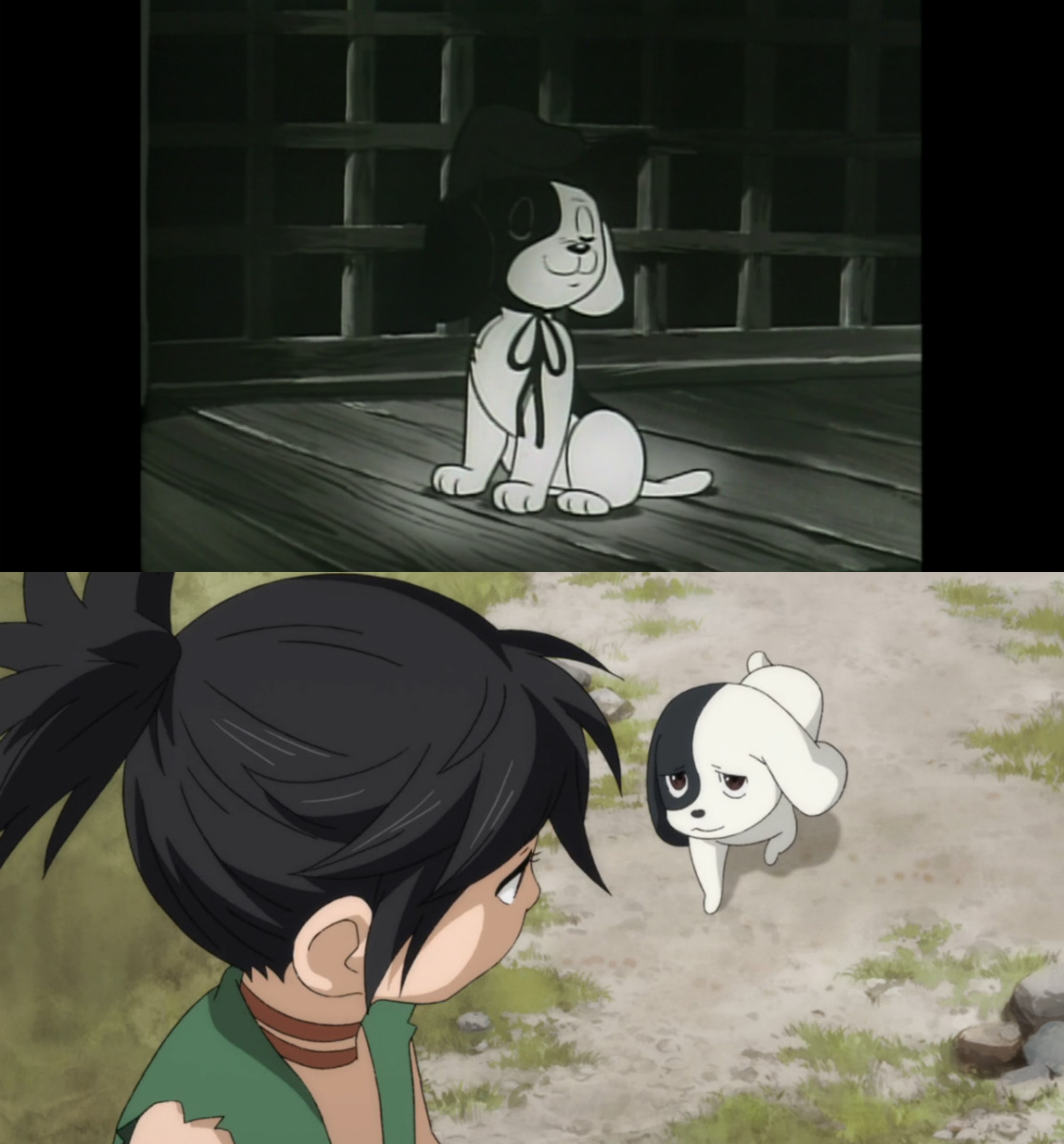
PS - Shout out to Mappa for putting a dog into their first episode that resembles Nota, the mascot character invented for the 1969 Mushi Pro series in a vain attempt to prevent children watching it from being emotionally scarred (it probably didn't). 

Dec 31, 2018

My Anime Picks for 2018


This is the second half of a two part blog series. If you missed the first half on my favorite video games of 2018, then you can read it here, otherwise please enjoy checking out some of the anime I liked the most in 2018. And for those who need a refresher, or just aren't interested in my gaming list, please remember that I do not think myself in any way shape or form an expert, and this is just a personal list I made up for my own amusement. Other than that just like the year before I am avoiding listing sequel seasons and won’t be talking about a long running anime unless it started this year in 2018--so even if I thought a show from a prior year--such as Black Clover--had a great run in 2018, I won’t be acknowledging that here. This list would just be too much of a mess if I did! Everything is presented in alphabetical order to so as to avoid ranking my chooses.

Devilman Crybaby


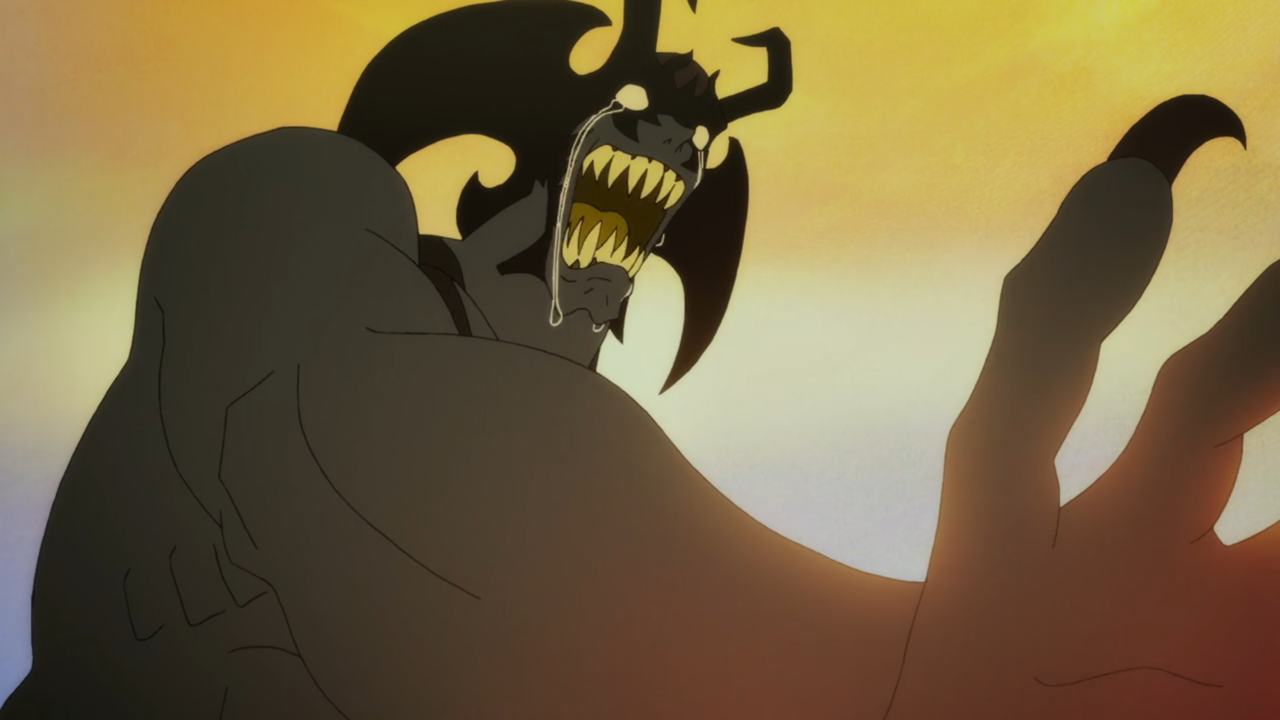
Devilman Crybaby began 2018 off with a huge bang, and was able to maintain its number one spot in my heart the entire year, an impressive feat considering its January premiere and just how good Megalo box, Planet With, and GeGeGe no Kitaro turned out. I wrote so much about Devilman already this year that I honestly can’t bring myself to sing any more praises for it by this point, but it definitely deserves all my praises and more. Crybaby was an absolutely beautiful and chilling re-imagining of a true classic, done justice by an auteur creator. If you want to read a bit extra about it, check out the piece I wrote about Devilman in my Halloween series this year.

GeGeGe no Kitaro

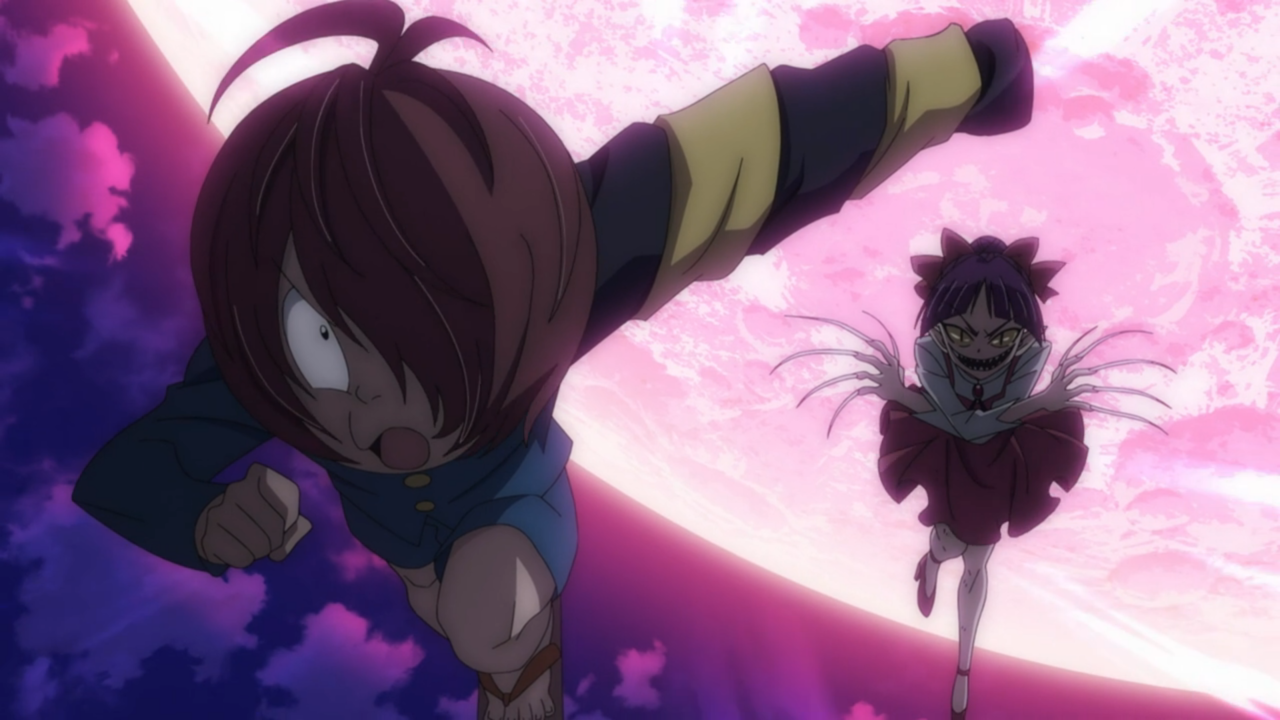
2018 marked the 50th anniversary for a lot of legendary properties and legendary creators. This was Go Nagai’s 50th anniversary as a comic artist, and the 50th anniversary of the Ashita no Joe manga, but perhaps one of the most important of the big 5-0 anniversaries this year was the 50th anniversary of the GeGeGe no Kitaro anime series. After the passing of comic legend Shigeru Mizuki in 2013 there is something all the more meaningful to see Kitaro on the small screen again--even after his creator’s passing Kitaro is still there to grow up with another generation of children. This is another anime series I talked ad nauseam about during my Halloween series this year, so I don’t want to go on too much now, but I will say this has easily been the highlight of all my Sunday mornings since it started in April, and this is the series that Mizuki and his legacy deserved. It’s doing one hell of a job kicking most “adult” anime's asses in terms of writing quality and animation, all while still being a kid show. It never talks down to its young audience either and tackles some really modern issues such as smartphone overuse, bullying, refugees that lost their own country, and even suicide.


The Girl in Twilight (Akanesasu Shoujo)

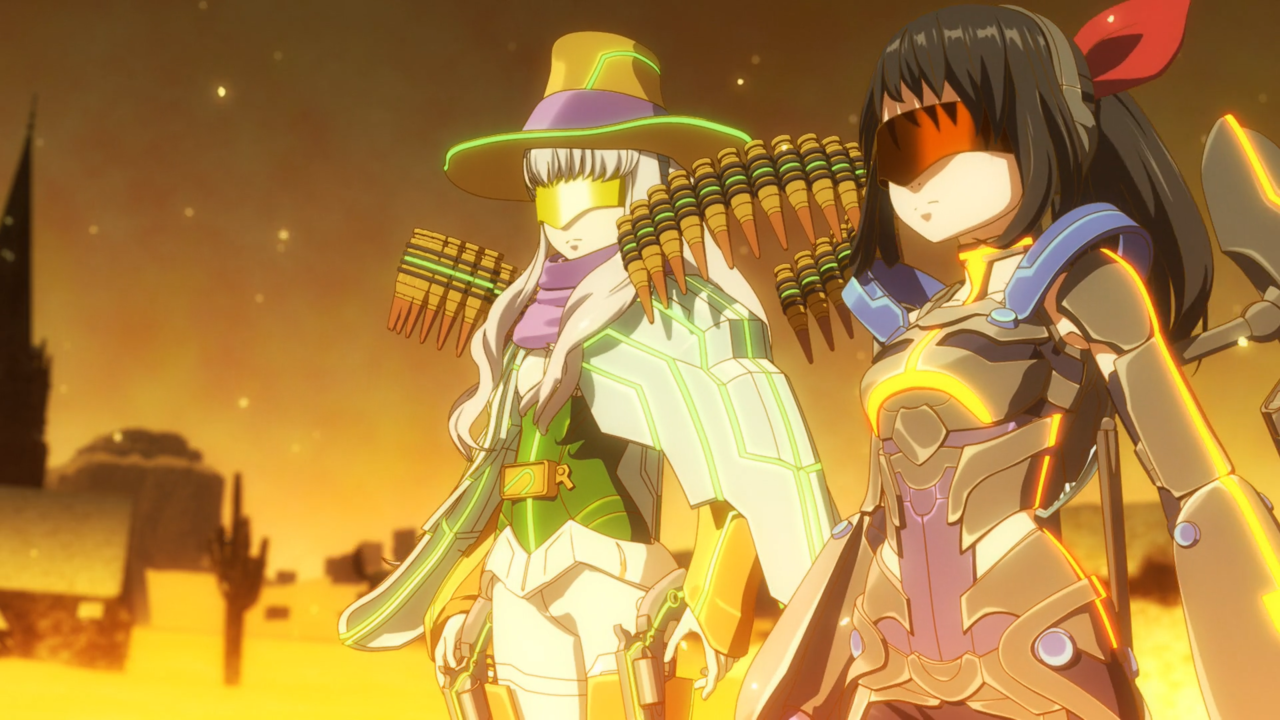
The Girl in Twilight is pretty much the last thing I expected but somehow I came around to really enjoying it. From the mind of Kotaro Uchikoshi, the creator of the Zero Escape, comes … well .. ah … a magical girl show? About traveling to different parallel worlds? Where hijinks ensue and it’s more a story about growing up? Yeah, this … is a hard one to explain, and not really what I would expect with Uchikoshi’s name attached. I mean 999: Nine Hours, Nine, Persons, Nine Doors, this is definitely not, but well, this isn't half bad. The science fiction elements about radio frequencies and different worlds definitely feels like something out of an Uchikoshi game and all the all girl cast is actually very charming and sweet. I got really invested in seeing them grow up and face their inner problems. So a weird show, and nothing too special either, but this really grew on me personally.

Gundam Build Divers


The original Gundam Build Fighters anime in 2013 was like a phenomenon that caught literally everyone off guard. This silly little kid’s show meant to sell toys was somehow one of the best anime the year it aired and was made with so much love and attention to detail that it was a better anniversary present to the Gundam franchise than some of the actual anniversary celebrations. Ever since the original fans have been pretty divisive on the sequels, and while Build Divers is still not the original, I think it’s the closest we've come out of all the past sequel seasons and OVAs in the “Build” sub-series. I really enjoyed the Virtual Reality angle of the series, and thought the creative team did a lot to give the series an identity of its own instead of feeling like a dull retread of the original Build Fighters like Try did. So wrap that together a great main cast, and some pretty fun team battles and I say this was a win for Gundam fans.

Gurazeni: Money Pitch


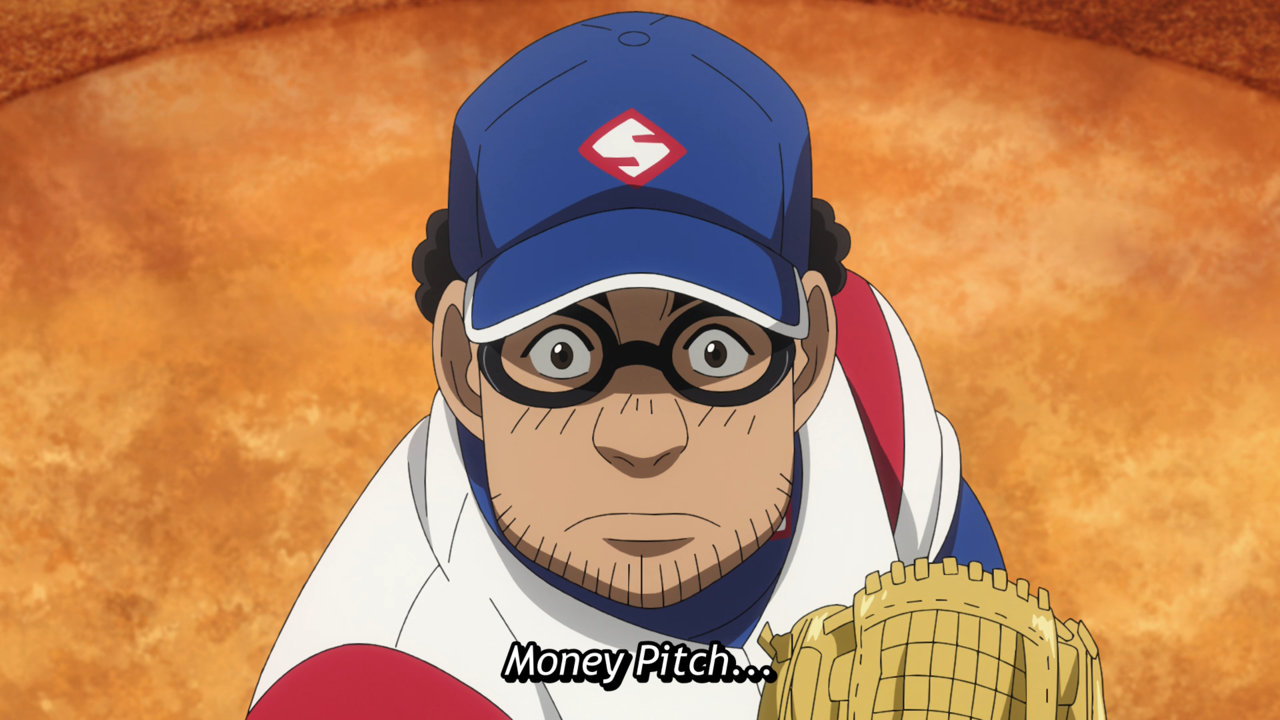
Gurazeni is an anime I think most people never gave a fair chance. What seems like a basic sports series with a weird focus on money turns out to be so much more. It’s an inside look at the professional world of Japanese baseball, where you can really learn all the ins and outs and what makes the business end tick. The most interesting part however is that this is not your usual series starring a High Schooler with some grandiose dream, but a cast of adult professionals, many of which are just struggling to get by and stay in the game. It’s a completely different kind of feeling. 

Professionals play some 100+ ball games a seasons. With that many games it’s not like they are all hot blooded screaming matches and if you lose once you’ll be out of the tournament. You gotta play smart, you got to think about your stats during the season, you gotta make sure you secure your spot on the roster for next year, if you excuse the horrible pun, this is a whole different kind of ball game. That’s what made Gurazeni so much fun every week, it’s more a calm collective observation about life in the major league for most players who aren't big celebrity stars instead of the usual shonen anime fair with some hot shot kid with a dream. I greatly enjoyed every laid-back episode of this show.

How to Keep a Mummy (Miira no Kaikata)

Cute!!! This is probably how I can define every single episode of this quirky pet comedy anime. Whoever knew mummies, dragons, and ogres could make such adorable pets. This was a basic “feel good” slice-of-life series where not much ever happened in each episode but it was such a nice reprieve from real life that the audience wouldn't mind. You didn't watch this for the plot, you watched this to just relax and smile for a half an hour, and How to Keep a Mummy accomplished this goal expertly. 

Karakuri Circus


Karakuri Circus is maybe one of the most underrated anime of the year, and it’s a darn shame considering the attention Ushio & Tora was eventually able to garner. Hopefully Karakuri Circus can one day get the same kind of tight knit following that its predecessor did. And if you couldn't tell already, Karakuri Circus is based off a manga by Kazuhiro Fujita, the creator of Ushio & Tora. Both series share the same well written and fleshed out character writing that Fujita is known for, and for fans of Ushio & Tora there is also the bonus treat of one of the three main protagonists, Narumi Kato, is literally just Tora from Ushio & Tora. The two characters share very similar appearance (when Tora was a human) and have the same personality. The Karakuri Circus anime even went the extra mile by casting the same exact actor for the roles. 

Unfortunately Karakuri Circus has the unenviable job of trying to adapt a weekly manga that is 43 volumes long in just 36 episodes, which means a lot of stuff has to be skipped over, condensed, and simplified, but for those of us who are watching I think we can all agree the studio is doing a great job at picking what to animate. The pace may be very brisk, but it sort of has that OVA kind of feeling to it with how fast it moves. You know, how a movie or an OVA can seemingly get so much story told in just a couple hours versus how a TV show may tell a story over the span of multiple months. Karakuri Circus definitely feels more like the former than the latter. 

Even with its faults however, this anime really shouldn't be as passed over as it has been. Karakuri has the most heart and it’s easily the most ridiculous and fun shonen battle anime airing right now, and that’s saying a lot considering JoJo is airing right now too!

Lupin the Third - Part V


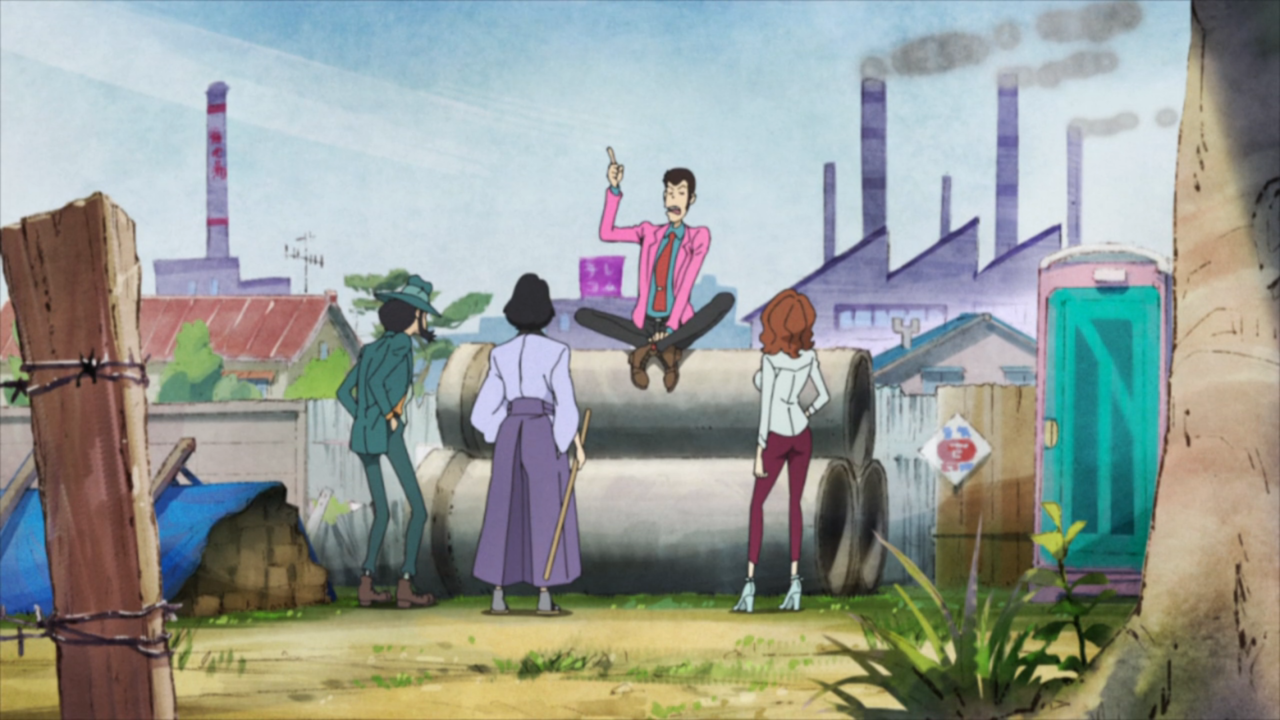
As somebody who was greatly disappointed by Lupin the Third Part IV I came into Part V expecting more of the same, but walked out blown away! This is everything I wished Part IV was, and it seems like the staff really learned from all their mistakes and were able to come together to make a very memorable Lupin series. My favorite has to be all the anniversary episodes that feature Lupin in his old jackets and the animation style changing over to how each previous series was animated. As a long time Pink Jacket Lupin fan I was in heaven, it’s probably been about 20 years since Lupin acknowledged the Pink era! Glad they were able to have so much fun with that particular throwback episode. 

Megalo box


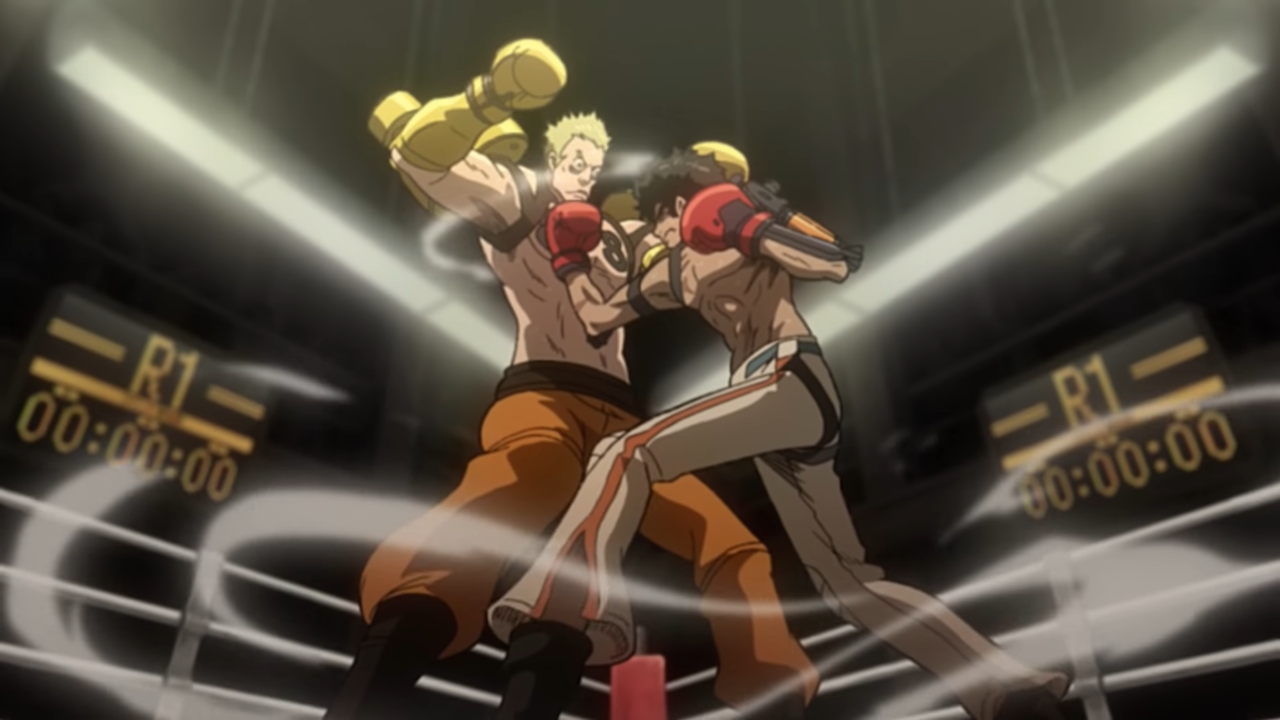
As mentioned earlier, Megalo box is the 50th anniversary project for the Ashita no Joe manga series, and one hell of a fantastic anime to boot. Everything from the animation to the music is top notch and invokes the feeling of the late 90’s and early 2000’s era of anime. It’s both nostalgic and new, and I think that’s a great way to pay homage to such a classic series. Megalo box is its own thing entirely while also reinventing many of the great moments from the original Ashita no Joe like some mirror that both reflects and distorts--it’s Ashita no Joe, it’s Megalo Box, it’s a classic reborn, it’s like nothing you have ever seen before. Megalo box is such a wild ride with thought provoking episodes and a crap ton of adrenaline rushing fights, and I can sing its praises all night if you let me, but the less said about each twist and turn, the better, so I think I’ll leave it at that. Easily one of the best anime in years, and had it not been for Devilman Crybaby it probably would have had my number one spot.

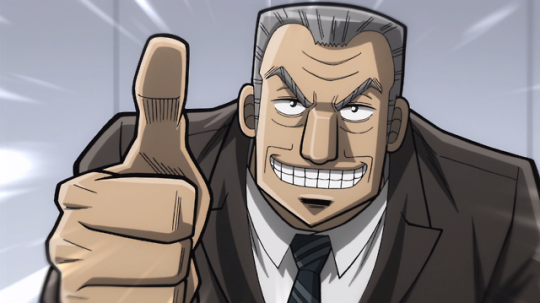
Mr. Tonegawa: Middle Management Blues (Chuukan Kanriroku Tonegawa) 


Mr. Tonegawa: Middle Management Blues is one of those weird spin-offs where you don’t really need to be familiar with the source material because … well it’s barley like the series it spun off of. This comedy centered around the Kaiji manga side character Yukio Tonegawa is best described as office humor, and it’s pretty straightforward with its premise of a hugely important businessman and his daily woes at his job. It’s sharp witted, and pretty funny but I think what made this series special to me was because it was the first “dubcast” anime from Sentai Filmworks I watched on Hidive, and I have enjoyed hearing all these different dub actors each week. I've gotten pretty use to hearing the Funimation and California based dub actors in weekly dub premieres, but hearing Sentai actors is quite something, and damn does this dub knock it out of the park. The real MVP of the show is by far David Wald as the narrator who can manage a laugh out of anyone no matter what the dialogue might say.


Muhyo & Roji’s Bureau of Supernatural Investigation


Muhyo & Roji is a Shonen Jump manga from 2004 that never really got its due credit. The manga was popular enough to maintain its spot in the magazine for many years but it never got an anime until this year. Was it worth the wait? Well, yeah, this is a classic Jump battle horror manga, with some good creepy monsters, and fun battles. I really enjoyed this show and I’m glad Muhyo & Roji finally got their moment of spotlight on the small screen. It brought back a lot of warm feelings from the early 2000', almost like a lost show from back then that I missed!

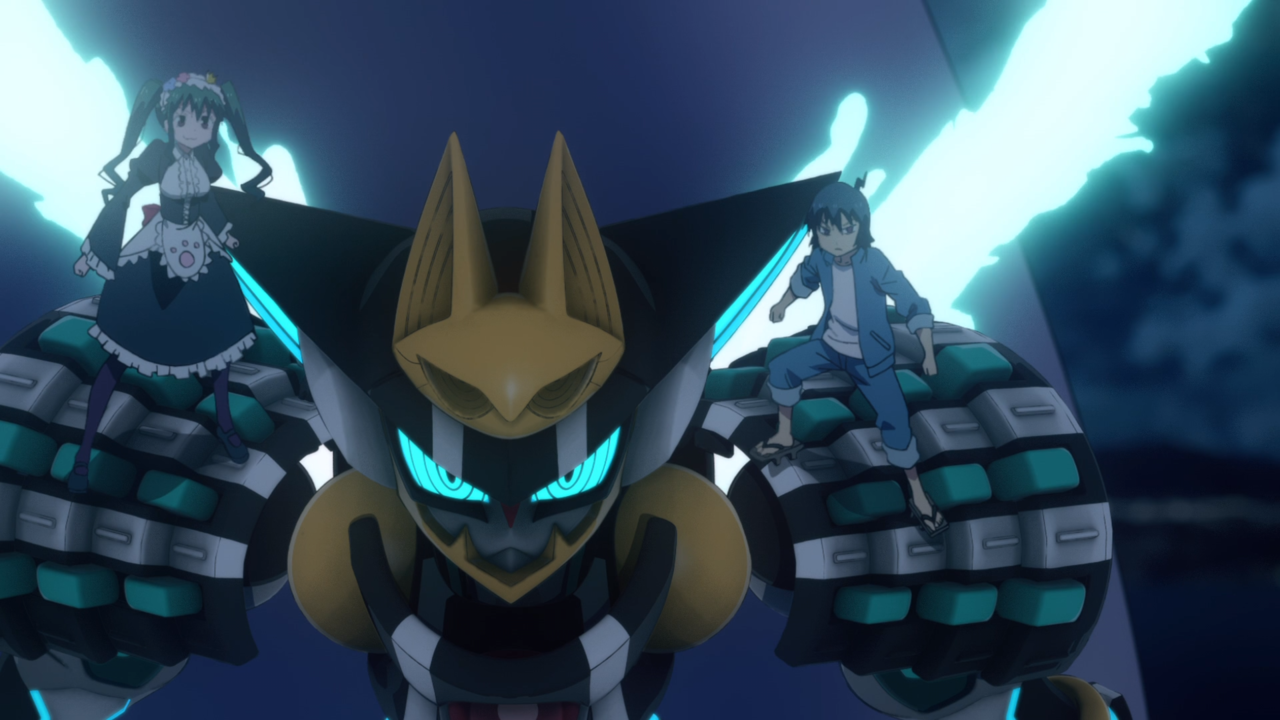
Planet With


Planet With is weird. It involves a giant cat monster eating a young boy and turning into a super battle robot that said boy pilots and uses to get his revenge on the psychics who protect the earth from evil invading aliens. That’s … sure is something, but it’s just what you would expect from an original story penned by Satoshi Mizukami, the creator of cult hit manga Lucifer and the Biscuit Hammer and Spirit Circle. Just like Megalo box this is a bit hard of a series to talk about without spoiling all the best moments, but just know, the plot twist keep coming, and the game keeps changing, and everything gets more and more insane, and more awesome. This is one hell of a ride, and was also a major contender for my number one spot, personally. It's a show that anyone who enjoys the werid and anyone with a sense of humor definitely has to check out. You may come for the humor, but you will stay for the well written character moments ... and giant cat robot battles.

Skull-face Bookseller Honda-san (Gaikotsu Shotenin Honda-san)


Have you ever worked in retail? Well Skull Face Honda knows your pain! This skeleton man has been stuck working in a book store and has all kinds of stories to tell. This humorous look into the life of book salesmen and the manga market is a fun little series. There’s tons of insight on not just the retail industry but also manga publishing companies as well. It’s a great little short anime that packs a lot of laughs. 

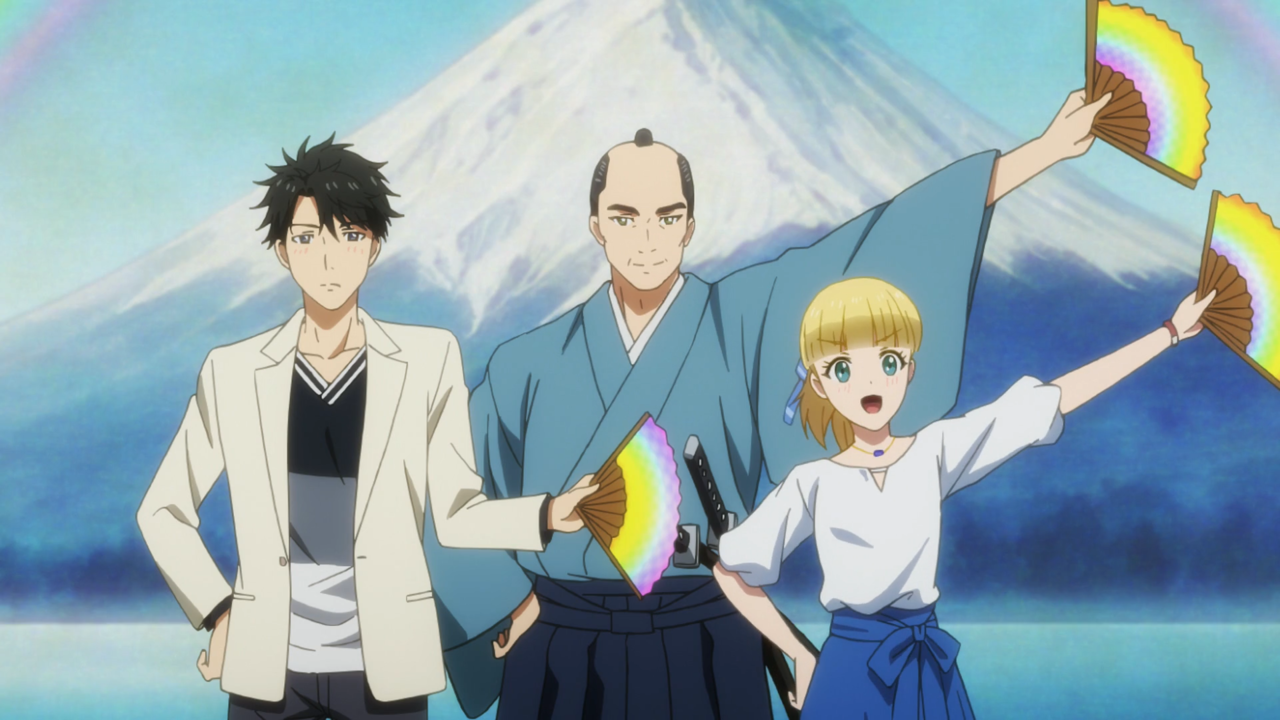
Tada Never Falls in Love (Tada-kun wa Koi wo Shinai)


Tada Never Falls in Love reunites most of the staff from the popular 2014 anime series Monthly Girls' Nozaki-kun, and features a lot of the same kind of humor and characters. It’s a very laid back anime for most of its runtime, which lets the romance bud between the two leads at a more believable pace, and the final payoff is heart wrenching. As someone that has fallen in love with the wrong person in my past, I know all too well how much it can hurt to begin to harbor feelings for someone you know you can never be with and that heck you should never be with. The final few episodes of this series packs such a punch to the gut, and it’s really what won me over.

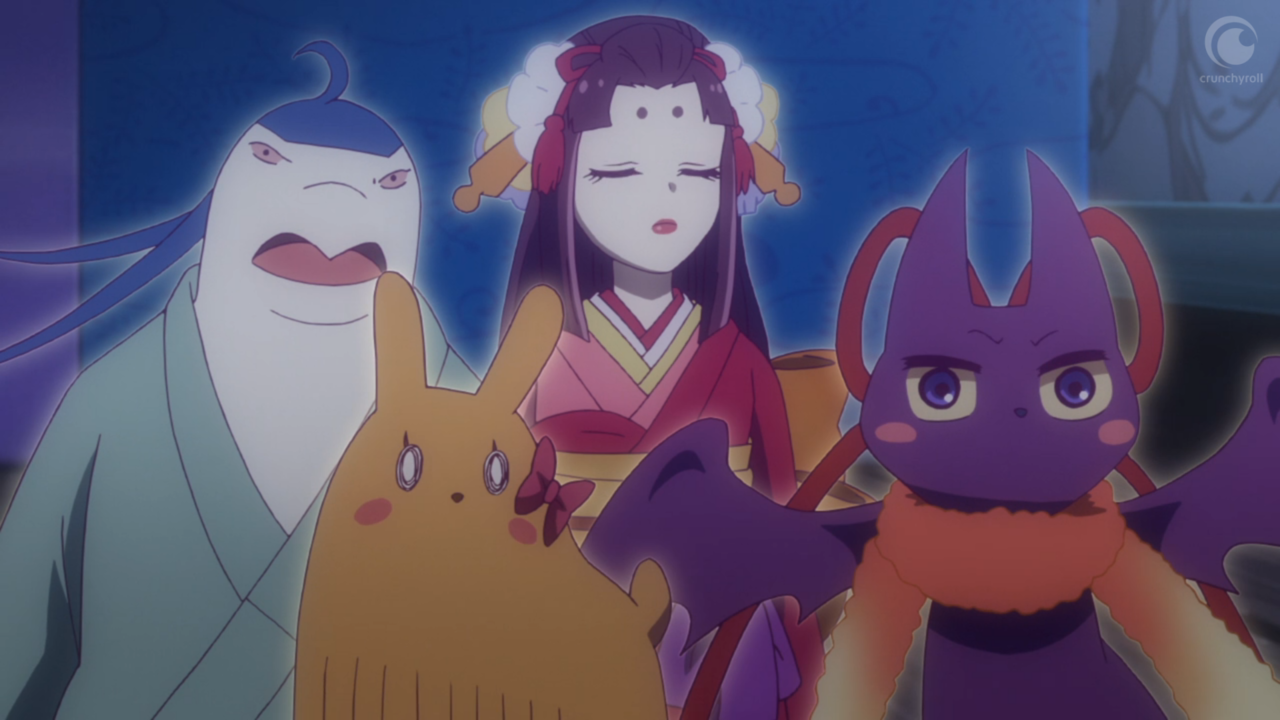
We Rent Tsukumogami (Tsukumogami Kashimasu)


Did anyone besides me actually watch this anime? It got no love whatsoever and that always bummed me out whenever I watched an episode. It’s such a cute episodic show about a rental store that has tsukumogami, or inanimate objects that have souls and can come alive. Every week a tsukumogami is used to solve some sort of problem in the neighborhood, and it’s just a delight to see how these little dolls, tobacco pipes, and combs can be used to find out everything from cheating husbands, to phantom thieves. Of course the real treat is seeing how all these episodic stories eventually weave together into one greater narrative, and that characters often become reoccurring within the neighborhood, so even after their own episode is solved they still have roles to play within the greater story. You can really tell this anime started life as a novel, it’s so well written. 

BONUS ENTRY: -Biggest Anime Surprises-

Perhaps the biggest surprise for me personally this year for anime was that I actually spent more than any human ever should on the Legend of the Galactic Heroes blu-ray box set. No kidding, this thing haunted me most of the year, and makes for one hell of a conversation starter. “Yeah, I am one of the few 1,000 elite that own Legend of the Galactic Heroes in English, what of it?” I say, while my guest stare at me confused as to what the hell Legend of the Galactic Heroes even is and why there is apparently only 1,000 of it to go around. 


But in all seriousness now, Sentai Filmworks really impressed me personally this year. Their hidive streaming service has become one of my favorite to use this year to stream anime, and I watched so many great classics on it; Legend of the Galactic Heroes Gaiden, Blue Gale Xabungle, Space Runaway Ideon, Glass Mask (1984), Armored Troopers Votoms, Aura Battler Dunbine, and the list goes on. This year was a huge year for streaming classic 80’s anime in large part do to Hidive. And now Sentai/Maiden Japan are releasing a large chunk of these anime on blu-ray which is something I never thought I would live to see the day. You can buy the entire Space Runaway Ideon series on BD right now if you wanted to. What a time to be alive! Perhaps the biggest surprise was their acquisition of Armored Troopers Votoms, a show I wanted someone to license rescue for close to a decade now. I always regretted missing out on the original Central Park Media (man they don’t even exist anymore!) DVD release back in 2001. I always thought it would be Discotek coming to the rescue for Votoms, but you know what, I’m glad to see it was Sentai. The more companies putting classics on BD the better, I say.

I hope you all enjoyed my anime list and have a great new year! Happy 2019!!!